Food Temperatures
Food safety temperatures: why food is cooked, cooled, held hot and reheated the way it is

Liam Jones

Founder of Pilla
Date Modified
22 November 2026


Date modified: 22nd November 2026 | This article has been written by Pilla Founder, Liam Jones, click to email Liam directly, he reads every email.
Food safety temperatures are the temperatures food is cooked to, cooled through, held at and reheated to, so harmful bacteria are killed or can't grow. Here is why each one is set the way it is, what the danger zone means, and how to probe and record it.
Article Content
Food safety temperatures are the set temperatures a kitchen uses to keep food safe: hot enough when it's cooked to kill harmful bacteria, cold enough in storage to stop them growing, cooled fast enough to get through the warm range quickly, held hot enough during service, and reheated hot enough all the way through. Each one has the same goal: kill the bacteria, or stop them multiplying.
Bacteria grow fastest in a warm middle band of temperatures, often called the danger zone. Most food safety temperatures are really about one of two things: getting food out of that band quickly, or keeping it out.
Food temperatures at a glance
- The danger zone is the warm band, roughly between fridge temperature and hot holding temperature, where bacteria grow fastest.
- Cooking kills most harmful bacteria if the centre of the food gets hot enough for long enough.
- Cooling has to be fast, because cooked food passes back through the danger zone on the way down.
- Hot holding keeps cooked food above the danger zone during service.
- Reheating must make food piping hot all the way through, and only once.
- Cold holding keeps chilled food below the danger zone. Our guide to fridge temperature covers it.
- The exact numbers differ by country. Use the ones in your food safety plan, and check them with a probe.
What it is, and why it matters
Bacteria such as salmonella, campylobacter, E. coli and listeria are common on raw food and in kitchens. A small number usually won't make anyone ill. The problem comes when they multiply. In warm conditions, some bacteria can double in number every 20 minutes or so. A few hundred can become millions in a single afternoon on the side.
Temperature is the most powerful control a kitchen has over that growth:
| Temperature | What happens to bacteria |
|---|---|
| Freezing | Growth stops, but most bacteria survive and wake up when the food thaws |
| Fridge temperature | Growth slows right down. A few, such as listeria, still grow slowly |
| The danger zone, roughly 5°C to 60°C | Growth is fastest, especially around body temperature |
| Hot holding temperature | Growth stops |
| Cooking temperature at the core | Most harmful bacteria are killed, if held long enough |
The exact edges of the danger zone differ a little between countries' guidance, which is one reason to use the figures in your own food safety plan.
Time matters as much as temperature
Killing bacteria by cooking depends on both how hot the food gets and how long it stays there. A lower temperature held for longer can do the same job as a higher one held briefly. That's why guidance often gives a pair, such as a core temperature held for a set time. And it's why the time food spends in the danger zone, when it's cooling or sitting out, matters as much as how warm it gets.
How it works in practice
Cooking
Cook food until the thickest part, the core, reaches a safe temperature. Many food safety bodies use 75°C as a check for most cooked food, or a lower temperature held for longer, such as 70°C for two minutes. The USDA's safe minimum internal temperature chart gives 74°C (165°F) for poultry and lower figures for some whole cuts of meat, with a rest time.
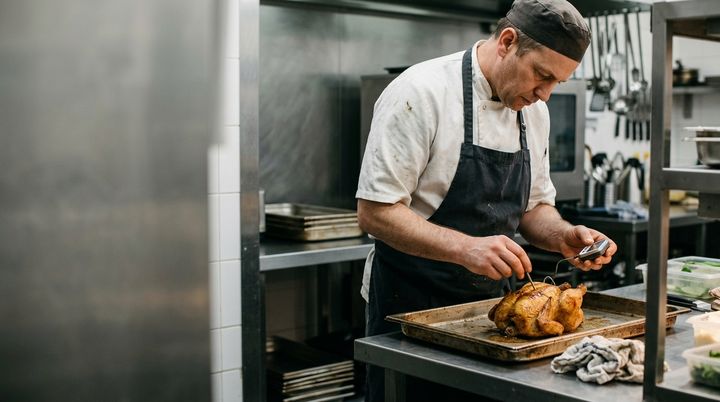
- Probe the thickest part, away from bone and away from the pan.
- Probe more than one item in a batch, and the biggest piece.
- Minced meat, poultry, stuffing, rolled joints and reheated food need cooking right through, because bacteria from the surface have been mixed into the middle.
- Some foods, such as rare steak or sous vide dishes, are cooked to lower temperatures on purpose. They need a written method that shows they're safe.
Our cooked food temperature check records the probe reading at the pass. There's more on fish in our guide to cooking fish safely.
Cooling
Cooked food that's going to be chilled has to get through the danger zone fast. Left to cool slowly on the side, a pot of stock or a tray of rice can spend hours in the band where bacteria grow fastest, and some of those bacteria make toxins that later reheating won't destroy.
- Cool in shallow trays, not deep pots.
- Cut large joints into smaller pieces.
- Stir sauces and stews, or stand the container in iced water.
- Use a blast chiller if you have one.
- Cover once cool, label and refrigerate.
- Check the temperature at the end of the cooling time and write it down.
Our guide to cooling food safely covers this, and the food cooling temperature check records it.
Hot holding
Once cooked, food held for service must stay above the danger zone. In many countries that means above about 60°C to 63°C, with the exact figure set by local rules.
- Heat food fully first. Hot holding equipment keeps food hot; it doesn't heat it up safely from cold.
- Stir often so there are no cool spots.
- Check temperatures through service, not just at the start.
- Set a time limit for food on display, after which it's thrown away.
Our guide to hot holding, the hot holding temperature check and our guide to hot buffets and functions cover this.
Reheating
Reheated food must be piping hot all the way through, steaming throughout, with the core checked by probe. Most guidance uses at least the same core temperature as cooking, and some places set a higher one. Reheat only once. Food reheated and cooled twice has spent two spells in the danger zone. Our guide to reheating food safely has the steps.
Freezing and defrosting
Freezers should keep food frozen hard, usually at about -18°C or colder. Freezing stops growth but doesn't kill most bacteria, so food should be defrosted in the fridge, not on the side, and cooked within a short time once defrosted. Our freezer temperature check keeps an eye on the freezer itself.
Probes
Every reading is only as good as the probe. Clean and disinfect it between foods, especially between raw and cooked. Check it regularly against a known temperature, such as iced water or boiling water. Our food probe accuracy test walks through how.
A worked example
A restaurant makes chilli in a 20-litre pot on Monday afternoon for Tuesday's lunch. The chef leaves the pot on the side to cool before it goes in the walk-in. At 10pm it's still warm in the middle.
The pot is too deep to cool quickly; the outside is cool, but the centre has spent hours in the danger zone. The new method is to split the chilli into shallow gastronorm trays as soon as it's cooked, stand them over ice, stir, and get them into the fridge within the time the kitchen's food safety plan sets. The chef probes one tray at the end and logs the reading. On Tuesday, it's reheated in batches until piping hot, probed, and held hot in the bain-marie.
Common mistakes and myths
| What people say | What's actually true |
|---|---|
| "Let it cool before it goes in the fridge" | Cool it fast in shallow trays, then get it chilled. Slow cooling is the risk |
| "It's bubbling at the edges, so it's done" | The core is what counts. Probe the middle |
| "The hot cupboard will heat it up" | Hot holding kit keeps hot food hot. Heat food fully first |
| "Freezing kills bacteria" | It stops them growing. Most survive |
| "Reheating a second time is fine if it's hot enough" | Each cycle spends time in the danger zone, and some toxins survive heat. Reheat once |
| "The probe was fine last month" | Check it regularly, and clean it between every use |
| "The numbers are the same everywhere" | The figures differ by country. Use the ones in your food safety plan |
Where it fits
Cooking, cooling, hot holding and reheating are usually the critical control points in a HACCP plan: the steps where getting the temperature right is what keeps the food safe. Each one needs a limit, a check, a record and a plan for what to do when the check fails.
Rules where you are
The legal temperatures for cooking, cooling, chilling, hot holding and reheating, and the records required, differ by country, and sometimes by state or region. These regulators keep their own pages up to date, so check yours:
- England, Wales and Northern Ireland: the Food Standards Agency, cooking safely and chilling food correctly
- Scotland: Food Standards Scotland, the CookSafe guide
- Ireland: the Food Safety Authority of Ireland, temperature control for caterers
- United States: the Food and Drug Administration, your state's food code
- Canada: Health Canada, safe cooking temperatures, plus your provincial public health rules
- Australia: Food Standards Australia New Zealand, cooling and reheating food
- New Zealand: the Ministry for Primary Industries, top 5 food safety factors
FAQ
What is the danger zone in food safety?
The warm band of temperatures, roughly between fridge temperature and hot holding temperature, where harmful bacteria grow fastest. The exact limits differ slightly between countries' guidance.
What temperature should food be cooked to?
Hot enough at the core to kill harmful bacteria. Many food safety bodies use 75°C as a check, or a lower temperature held for longer, and some foods have their own figures. Use the temperatures in your food safety plan and check with a probe.
Why does food need to be cooled quickly?
Cooked food passes back through the danger zone as it cools. The longer it stays there, the more bacteria can grow, and some make toxins that reheating won't destroy.
How many times can you reheat food?
Once. Each time food is cooled and reheated it spends more time in the danger zone, so reheat it until piping hot all the way through, and throw away what's left.
How hot should hot holding be?
Hot enough to keep food above the danger zone, which in many countries means above about 60°C to 63°C. Check the figure that applies where you are, and probe food during service.