E. coli O157
What is E. coli O157? Why it's so dangerous and how kitchens keep it out of food

Liam Jones

Founder of Pilla
Date Modified
22 November 2026


Date modified: 22nd November 2026 | This article has been written by Pilla Founder, Liam Jones, click to email Liam directly, he reads every email.
E. coli O157 is a strain of E. coli that makes a toxin and can cause severe illness from a tiny dose. Here is where it comes from, why it's so dangerous, and the separation, cleaning and cooking that keep it out of the food you serve.
Article Content
E. coli O157 is one strain of the bacterium Escherichia coli that produces a powerful toxin, called Shiga toxin, and can cause severe illness. Most types of E. coli live harmlessly in the gut of people and animals. O157 is different: it can cause bloody diarrhoea, and in some people, especially young children and older adults, a kind of kidney failure that can be fatal.
Two things make it a particular worry for food businesses. Only a very small number of bacteria are needed to make someone ill, so a tiny amount of cross-contamination is enough. And it can't be seen, smelled or tasted.
E. coli O157 at a glance
- It's one of a group of E. coli that make toxins, sometimes called STEC or VTEC. O157 is the best known.
- It lives in the gut of cattle, sheep and other animals, so raw meat, unpasteurised milk and soil can carry it.
- A very small dose can cause illness. That's why cross-contamination is the main danger.
- It can cause serious illness, including kidney failure, especially in young children and older people.
- Keep raw and ready-to-eat food completely apart, including equipment, surfaces, storage and hands.
- Cook minced meat and burgers thoroughly, and wash produce well.
What it is, and why it matters
Where it comes from
E. coli O157 is carried in the gut of healthy cattle, sheep, goats and deer. It reaches food in several ways:
| Source | How it gets into food |
|---|---|
| Raw meat, especially minced beef | From the animal's gut during slaughter, then spread through the meat when it's minced |
| Unpasteurised milk and dairy | From the animal during milking |
| Vegetables, salad and fruit | From soil, manure or contaminated water on the farm |
| Water | Contaminated private supplies or water from fields |
| Animals and farms | Direct contact at farms and petting zoos, then hand to mouth |
| People | From an infected person who doesn't wash their hands properly |
Why it's so dangerous
Most food poisoning bacteria need to multiply to large numbers before they make someone ill, so good temperature control does most of the work. E. coli O157 can cause illness from a very small dose. A smear of raw meat juice on a knife, a board or a hand can carry enough.
That changes the focus. Temperature control still matters, but the main protection is keeping raw and ready-to-eat food completely apart, all the time, everywhere in the kitchen.
What illness it causes
Symptoms usually start a few days after eating contaminated food: stomach cramps and diarrhoea, often bloody. Most people recover within a week or so. But some, especially children under five and older people, develop haemolytic uraemic syndrome (HUS), which damages the kidneys and can be life-threatening.
A worked example
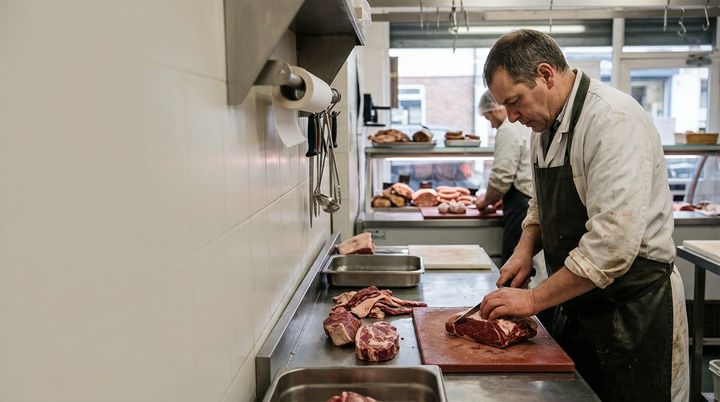
A butcher's shop sells raw meat and cooked meats from the same counter. Staff use one vacuum packer for both, cleaning it between uses. They use one set of scales, and one person often serves raw and cooked meat in the same transaction, changing gloves in between.
Each step seems reasonable. But a vacuum packer is hard to clean thoroughly: E. coli can survive in the seals and hinges. The scales get touched by hands that have handled raw meat. Gloves picked up from a box next to the raw meat can be contaminated before they're even on.
The safer set-up is complete separation: one vacuum packer for raw meat, another for cooked; separate scales, separate areas, ideally separate staff for each, and a hand-washing point between. These are exactly the kinds of separation our E. coli control training teaches.
How kitchens control it
Separate raw and ready-to-eat food completely
| Area | What separation looks like |
|---|---|
| Storage | Raw meat below and away from ready-to-eat food, ideally in a separate fridge |
| Prep areas | Separate areas for raw and ready-to-eat food |
| Equipment | Separate boards, knives, utensils, containers and complex kit such as slicers, mincers and vacuum packers |
| Cloths | Separate, colour-coded cloths, or single-use |
| Staff | Ideally different people for raw and ready-to-eat tasks, or strict hand washing and a change of apron between them |
| Delivery | Raw meat checked and stored straight away, away from other food |
Complex equipment, such as slicers, mincers and vacuum packers, is very hard to clean and disinfect fully between uses. Using separate equipment for raw and ready-to-eat food is the safest answer. Our guide to cross-contamination covers separation in more detail.
Clean and disinfect properly
Use two-stage cleaning on any surface or equipment that could have touched raw meat, with a disinfectant that's proven to work and left for its full contact time. A quick wipe isn't enough.
Wash hands well
Wash hands thoroughly after handling raw meat, after touching anything that may be contaminated, after the toilet and after touching animals, before going near ready-to-eat food.
Cook it thoroughly
Minced meat, burgers, sausages and rolled joints must be cooked right through, because the bacteria from the outside of the meat have been mixed into the middle. A pink burger isn't a safe burger unless your business has a validated method for serving it that way. Our guide to food temperatures covers cooking temperatures.
Wash and prepare produce carefully
Wash fruit and vegetables that will be eaten raw, especially leafy greens and anything with soil on. Prepare raw vegetables with soil on them away from ready-to-eat food.
Keep ill staff away from food
Anyone with diarrhoea or vomiting should stay away from food handling until they've been free of symptoms for the time your food safety plan sets. Our guide to fitness to work after illness explains why.
Common mistakes and myths
| What people say | What's actually true |
|---|---|
| "We clean the slicer between raw and cooked" | Complex kit is very hard to clean fully. Use separate equipment |
| "Changing gloves is enough" | Gloves only help with clean hands and a clean box, away from raw meat |
| "It's only a tiny amount of juice" | E. coli O157 can cause illness from a very small dose |
| "A pink burger is fine if the meat is good quality" | Mincing spreads bacteria through the meat. Cook it through |
| "Washing salad isn't needed, it's pre-washed" | Bagged ready-to-eat salad is labelled as such. Raw produce with soil needs washing |
| "If nobody's ill, we're fine" | Contamination can be invisible until someone gets seriously ill |
Rules where you are
What food businesses must do to control E. coli and cross-contamination differs by country, and some regulators set out specific separation rules. These regulators and public health bodies keep their own pages up to date, so check yours:
- England, Wales and Northern Ireland: the Food Standards Agency, E. coli cross-contamination guidance
- Scotland: Food Standards Scotland, E. coli O157 control of cross-contamination guidance
- Ireland: the Food Safety Authority of Ireland, common food poisoning bacteria
- United States: the Food and Drug Administration, the Food Code, and the Centers for Disease Control and Prevention, signs of haemolytic uraemic syndrome
- Canada: the Public Health Agency of Canada, prevention of E. coli infection, plus your provincial public health rules
- Australia: Food Standards Australia New Zealand, microorganisms and foodborne illness
- New Zealand: the Ministry for Primary Industries, E. coli (STEC) infection
FAQ
What is E. coli O157?
A strain of E. coli bacteria that makes a toxin called Shiga toxin. It can cause severe illness, including bloody diarrhoea and, in some people, kidney failure.
Where does E. coli O157 come from?
From the gut of cattle, sheep and other animals. It can get into raw meat, especially minced beef, unpasteurised milk, vegetables grown in contaminated soil, and water.
Why is E. coli O157 so dangerous?
A very small number of bacteria can make someone ill, so a tiny amount of cross-contamination is enough. In young children and older people, it can cause kidney failure.
How do you prevent E. coli in a kitchen?
Keep raw and ready-to-eat food completely apart, including separate equipment for each, clean and disinfect properly, wash hands well, cook minced meat thoroughly and keep ill staff away from food.
Can you use the same equipment for raw and cooked food?
It's safest not to, especially for complex kit like slicers and vacuum packers, which are very hard to clean fully. Simple items can be shared if they're cleaned and disinfected properly in between, but separate equipment is better.