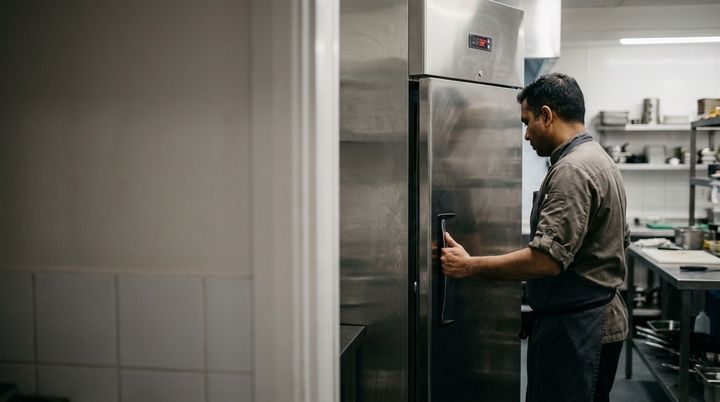
Fridge Temperature
Fridge temperature: what it should be, why 5°C, freezers and how to check

Liam Jones

Founder of Pilla
Date Modified
22 November 2026


Date modified: 22nd November 2026 | This article has been written by Pilla Founder, Liam Jones, click to email Liam directly, he reads every email.
Why most kitchens set their fridges at 5°C or below, why the food can be warmer than the display says, what a freezer should read, and how to check and record temperatures on every shift.
Article Content
A commercial fridge should be set at 5°C (41°F) or below, so the food inside stays cold enough to slow the growth of the bacteria that cause food poisoning. The fridge temperature on the display is the air. What matters is the food, and the food is often a degree or two warmer.
Fridge temperature at a glance
- Set fridges at 5°C (41°F) or below. That's the setting most food safety guidance recommends, and it leaves a margin.
- Air and food don't read the same. Check the food with a probe between packs, not only the display.
- Some food needs colder than your fridge setting. The maker's storage instructions on the label win.
- Freezers usually run at -18°C (0°F) or colder.
- Check at least once a day and write it down, along with what you did about any reading that was out.
- Cold slows bacteria. It doesn't stop them, and it does nothing to allergens.
What temperature should a fridge be?
Most food safety bodies recommend setting a commercial fridge at 5°C or below. The Food Standards Agency's Safer food, better business chilled storage sheet puts it plainly: "It is recommended that fridges and chilled display equipment should be set at 5°C or below." Food Standards Australia New Zealand uses the same 5°C line, and the US FDA Food Code uses 41°F, which is the same thing.
The setting is lower than the warmest the food is allowed to get, and that's on purpose. Many countries set an upper limit for the food itself, and that limit isn't the same everywhere. A fridge set at 5°C keeps food under any of them, even on a busy shift when the door keeps opening.
Some food needs colder still. SFBB says: "Some foods require storage at temperatures lower than 8°C to keep them safe so always follow the manufacturer's storage guidance." If a pack of smoked salmon says "store at 0 to 3°C", that's the rule for that pack.
Air temperature vs food temperature
The number on the display is the air near the sensor. Food takes longer to cool and warm up, and the air near the door warms up every time someone opens it. A council guide from Eden District Council notes that "the air temperatures of refrigerators are often a few degrees lower than product temperatures". So a fridge showing 6°C after a delivery can be holding food at 9°C.
Picture a prep fridge on the pass at 7pm on a Saturday. The door opens forty times an hour, and the display reads 4°C because the sensor sits at the back by the fan. A probe pushed between two tubs of coleslaw at the front reads 8°C. The display isn't lying. It's just measuring something else.
What is the danger zone?
The danger zone is the band of temperatures where bacteria grow fastest, roughly from fridge temperature up to hot-holding temperature. Each country draws the lines slightly differently. The FSA's How to chill, freeze and defrost food safely guide calls it 8 to 63°C, and the US uses 41 to 135°F (5 to 57°C). The idea is the same: food that can grow bacteria spends as little time as possible in that band.
The FSA adds that "cold temperatures don't stop bacteria growing altogether (for example, listeria monocytogenes )". Listeria can grow slowly in a fridge, which is why a cold fridge doesn't stretch a use-by date.
What temperature should a freezer be?
-18°C (0°F) or colder is the figure most guidance uses. At that temperature bacteria can't multiply, though freezing doesn't kill them, so they wake up again when the food defrosts. Food Standards Scotland's CookSafe guidance says "Freezing of food at temperatures of -18°C or below will prevent bacteria multiplying."
A freezer reading a few degrees warmer for a short time during a defrost cycle or a delivery is normal. A freezer that sits at -12°C all day is not doing its job, and frozen food in it will lose quality fast and may start to thaw at the edges.
How do you check a fridge temperature, and how often?
At least once a day is the usual minimum, often at opening. SFBB says: "You should check the temperature of your fridges and chilled display equipment at least once a day starting with your opening checks." Many kitchens add a second check at close, because that's when a fridge left open or overloaded shows up.
- Read the display or dial and write it down.
- Check the display is honest. Once in a while, compare it with a fridge thermometer or a probe.
- Probe between packs. Put a clean, disinfected probe between two packs or tubs of chilled food. Don't pierce sealed packs.
- Act on anything out. Move the food, find the cause, check again, and decide whether the food is still safe.
- Write down what you did, not just the number.
| Reading | What to do |
|---|---|
| 5°C or below | Fine. Log it |
| Above 5°C, food still cold | Check the door seal, the load and the defrost. Re-check within the hour |
| Food above your upper limit | Move the food to another fridge. Decide whether to keep it or bin it, based on what it is and how long it's been warm |
| You don't know how long it's been warm | Treat the high-risk food as unsafe, and ask your local food safety officer if unsure |
| Freezer above -15°C for hours | Check the food for thawing. Don't refreeze anything that has defrosted |
For a ready-made way to log this, see the fridge temperature check and freezer temperature check templates.
Why fridges run warm
Most warm readings have a plain cause:
- the door was left open, or opened all through service
- warm food went straight in, instead of being cooled first
- the fridge is packed so tight that air can't move
- a door seal is split or the fan is blocked
- the fridge is next to an oven or in direct sun
- a defrost cycle had just run
What records are worth keeping?
A fridge log is the only proof the checks happen. It's also part of any food safety plan based on HACCP, where chilled storage is a point you monitor. A good record shows:
- the unit, the date and time, the reading and who took it
- what you did when a reading was out, and the re-check
- that your probe was checked for accuracy
The corrective action counts as much as the number. CookSafe gives a worked example: "If your refrigerator temperature Critical Limit is 5°C but your Monitoring check finds that the refrigerator is running at 12°C, then your Corrective Action could be: 'call the Maintenance Engineer and consider if the food is safe to use'." A log that shows 12°C three days running with nothing written next to it tells an inspector the checks happen but nobody acts on them. Our food safety management guide shows where the fridge log fits in the wider system.
Allergens and cross-contamination in the fridge
The fridge is where raw meat, allergens and ready-to-eat food end up a few inches apart, and cold does nothing to allergens. The SFBB food allergy sheet says "unlike bacteria, allergens are always present in the food and cannot be removed or destroyed by cooking".
A safe shelf order:
- Ideally, use separate fridges for raw and ready-to-eat food.
- If they share a fridge, put raw meat, poultry, fish and eggs on the bottom shelf, below ready-to-eat food.
- Keep allergen-free food apart and covered.
- Defrost raw food in the fridge, in a covered container, below ready-to-eat food.
- Label and cover everything, and clean up spills straight away.
Our guides to cross-contamination and allergen management cover the wider system.
Common mistakes and myths
| What people say | What's actually true |
|---|---|
| "The display says 4°C, so the food is fine" | The display is the air. Probe the food |
| "5°C is the legal limit everywhere" | 5°C is the usual recommended setting. Legal limits for the food differ by country |
| "A colder fridge means food lasts longer than its date" | Cold slows bacteria, it doesn't stop them. The use-by date still counts |
| "Put leftovers in hot so they chill faster" | Warm food heats everything around it. Cool it quickly first, then chill it |
| "A full fridge stays colder" | Packed too tight, the air can't move and the middle runs warm |
| "Freezing kills bacteria" | It stops them growing. They start again once the food defrosts |
| "Once a week is enough" | That's home advice. A business checks at least daily |
At home: what temperature should your fridge be?
Most people searching "fridge temperature" mean their kitchen at home. The FSA says "your fridge should be between 0 and 5°C and your freezer should be around -18°C", and recommends a fridge thermometer, checked once a week. The numbers on a home fridge dial usually aren't degrees, so a thermometer is the only way to know.
Pilla can run your fridge and freezer checks as a daily task on staff phones. It flags a reading above your limit and asks for the corrective action there and then.
Rules where you are
The legal limits for chilled and frozen food, and how they're enforced, differ by country. These regulators keep their own pages up to date, so check yours:
- England, Wales and Northern Ireland: the Food Standards Agency, chilling food correctly in your business
- Scotland: Food Standards Scotland, guidance on temperature control legislation
- Ireland: the Food Safety Authority of Ireland, temperature control for caterers
- United States: the FDA Food Code, adopted state by state: the FDA's state retail and food service codes
- Canada: Health Canada, safe food storage, plus your provincial food premises rules
- Australia: Food Standards Australia New Zealand, keeping food at the right temperature
- New Zealand: the Ministry for Primary Industries, food control plans
FAQ
Is 8°C OK for a fridge?
It leaves you no margin. Most guidance recommends setting a fridge at 5°C or below, so a fridge reading 8°C needs turning down, checking for a cause and checking again.
Is 7°C too warm for a commercial fridge?
It's above the 5°C setting most guidance recommends, so treat it as a warning. Probe the food, find the cause and write down what you did.
How often should I check fridge temperatures?
At least once a day, usually at opening. Many kitchens add a check at close, and some check every unit before and after service.
What temperature should a freezer be?
-18°C (0°F) or colder. A short rise during a defrost or a delivery is normal, but a freezer that sits warmer than that all day needs looking at.
Why is my food warmer than the fridge display?
The display reads the air near the sensor, and food warms and cools more slowly than air. Doors opening, warm food going in and a packed fridge all make the gap bigger.