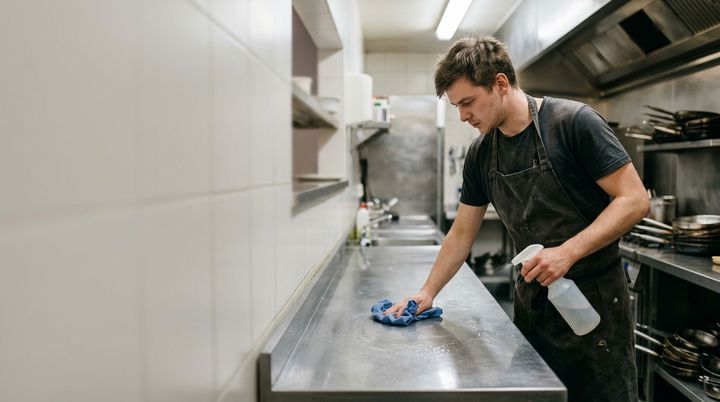
Two-Stage Cleaning
Two-stage cleaning: why you clean first, disinfect second and wait for the contact time

Liam Jones

Founder of Pilla
Date Modified
22 November 2026


Date modified: 22nd November 2026 | This article has been written by Pilla Founder, Liam Jones, click to email Liam directly, he reads every email.
Two-stage cleaning means cleaning a surface first and disinfecting it second, then leaving the disinfectant for its contact time. Here is why both stages matter, what contact time means, which products to use and the mistakes that undo the work.
Article Content
Two-stage cleaning means cleaning a surface first, to remove dirt, grease and food, and then disinfecting it second, to kill the bacteria that are left. The disinfectant has to stay wet on the surface for a set time, called the contact time, to work. Skip the first stage, rush the second, or wipe the disinfectant off too soon, and the surface can look clean while still carrying bacteria that make people ill.
It's the standard way to clean anything that touches ready-to-eat food or hands, such as chopping boards, prep counters, slicers, probe thermometers, fridge handles and taps.
Two-stage cleaning at a glance
- Stage one is cleaning. Remove visible dirt, grease and food with hot water and detergent, then rinse.
- Stage two is disinfecting. Apply a disinfectant or sanitiser to the clean surface and leave it for the full contact time.
- Contact time is on the label. It's how long the surface must stay wet for the product to kill bacteria. It can be 30 seconds or 5 minutes or more.
- Disinfectant doesn't work through dirt. Grease and food protect bacteria and use up the disinfectant.
- A combined cleaner-sanitiser still needs two goes: once to clean, once to disinfect.
- Use the right dilution and a clean cloth, or you spread bacteria rather than removing them.
What it is, and why it matters
Most people clean in one go: spray, wipe, done. The surface looks clean, but looking clean and being safe aren't the same thing. Bacteria such as E. coli, salmonella and campylobacter are invisible, and they can survive on a surface for hours.
Disinfectants kill bacteria, but they're easily stopped. Fat, blood, meat juice and crumbs shield bacteria from the chemical, and the dirt itself reacts with the disinfectant and uses it up. That's why the surface has to be physically clean before disinfectant can do its job. Cleaning removes most of the dirt and many of the bacteria. Disinfecting deals with what's left.
A worked example
A chef prepares raw chicken on a board, then needs the same counter for salad. In a hurry, they spray it with sanitiser and wipe it straight off with the same cloth they used earlier.
Three things went wrong. The chicken juice wasn't removed first, so the sanitiser was working through a film of protein and fat. It was wiped off straight away, well before its contact time. And the cloth had been used on raw meat, so it put bacteria back onto the counter.
Done properly, it takes a couple of minutes longer. Scrape off any bits. Wash with hot water and detergent. Rinse. Spray with sanitiser and leave it for the time on the label. Wipe or rinse if the label says to, with a clean cloth or paper towel. Better still, the salad goes on a separate board and area, so the raw chicken never touches that counter in the first place. Our guide to cross-contamination covers that side.
How it works in practice
The steps
- Pre-clean. Scrape or wipe off loose food and debris.
- Clean. Wash with hot water and detergent, scrubbing to remove grease and dirt you can see.
- Rinse. Remove the detergent and loosened dirt with clean water. Detergent left behind can weaken some disinfectants.
- Disinfect. Apply disinfectant or sanitiser at the right dilution, covering the whole surface.
- Leave it for the contact time. Don't wipe it off early. Set a timer if the time is long.
- Rinse or wipe if the label says so, especially on food contact surfaces, using clean water and a clean cloth or paper towel.
- Dry. Air dry, or use single-use paper towel. A damp reused cloth puts bacteria back.
Contact time
Contact time is the single most skipped step. It's printed on the label, and it's the time the product needs, wet on a clean surface, to kill the organisms it claims to kill. Different products have different times, and some have different times for different jobs.
| What to check on the label | Why it matters |
|---|---|
| Contact time | Wipe it off sooner and it may not have worked |
| Dilution | Too weak won't work. Too strong wastes product, can damage surfaces and may leave residue |
| Whether it's food safe | Some products need rinsing off food contact surfaces |
| What it's tested against | Some products are tested against bacteria only, some against viruses too |
| Temperature | Some work best in a certain temperature range |
Pick a product with a short contact time for surfaces you clean often during service. A product that needs five minutes won't be used properly on a counter that's needed again in thirty seconds.
The products
| Product | What it does | Used for |
|---|---|---|
| Detergent | Removes grease and dirt. Doesn't kill bacteria reliably | Stage one |
| Disinfectant | Kills bacteria on a clean surface | Stage two |
| Sanitiser | Usually a cleaner and disinfectant in one, or a disinfectant made for food areas | Both stages, used twice |
A combined cleaner-sanitiser can do both stages, but it still has to be used twice: once to clean off the dirt, then again on the clean surface for the full contact time.
Cloths
Cloths can spread bacteria from one surface to the next. Use single-use cloths or paper towel for disinfecting food contact surfaces, or reusable cloths that are washed on a hot cycle after each use. Many kitchens colour-code cloths so raw meat areas, ready-to-eat areas, front of house and toilets each have their own.
Dishwashers
A commercial dishwasher does both stages in one: hot water and detergent to clean, then a hot rinse or a chemical rinse to disinfect. It only works if the wash and rinse temperatures are reached and the chemicals are topped up. Our dishwasher temperature check keeps an eye on that.
Common mistakes and myths
| What people say | What's actually true |
|---|---|
| "One spray and wipe does it" | That's one stage. Disinfectant can't work through dirt and grease |
| "It looks clean, so it's clean" | Bacteria are invisible. Looking clean is stage one done, not both |
| "Sanitiser kills on contact" | Most need a contact time. Check the label |
| "Stronger is better" | The right dilution works. Too strong can damage surfaces and leave residue |
| "Our two-in-one product means one go" | It still needs two goes: clean, then disinfect |
| "The same cloth is fine if I rinse it" | A reused damp cloth spreads bacteria. Use clean or single-use cloths |
| "Hot water alone kills everything" | Water from the tap isn't hot enough to disinfect |
Where it fits
Two-stage cleaning belongs in every cleaning schedule for food areas. Your daily kitchen cleaning checklist should name the surfaces that need it and when. New starters need to see it done before they do it alone, which is what two-stage cleaning training and sanitiser use training are for. And cleaning chemicals are hazardous substances, so how they're stored and handled sits in your hazardous substances assessment too.
Rules where you are
What food businesses must do on cleaning and disinfection, and which products are approved, differs by country. These regulators keep their own pages up to date, so check yours:
- England, Wales and Northern Ireland: the Food Standards Agency, cleaning effectively in your business and E. coli cross-contamination guidance
- Scotland: Food Standards Scotland, E. coli O157 control of cross-contamination guidance
- Ireland: the Food Safety Authority of Ireland, HACCP-based procedures for caterers
- United States: the Food and Drug Administration, the Food Code, and your state's food code
- Canada: the Canadian Food Inspection Agency, preventing cross-contamination, plus your provincial public health rules
- Australia: Food Standards Australia New Zealand, cleaning and sanitising
- New Zealand: the Ministry for Primary Industries, food control plans
FAQ
What is two-stage cleaning?
Cleaning a surface first with detergent to remove dirt and grease, then disinfecting it second and leaving the disinfectant for its contact time. It's used on surfaces that touch ready-to-eat food or hands.
What is contact time?
The time a disinfectant or sanitiser must stay wet on a clean surface to kill bacteria. It's printed on the label and can range from a few seconds to several minutes.
What is the difference between cleaning and disinfecting?
Cleaning removes dirt, grease and food you can see, along with some bacteria. Disinfecting kills most of the bacteria left on a surface that's already clean. You need both.
Can I use one product for both stages?
Yes, if it's a combined cleaner-sanitiser, but you still use it twice. Use it once to clean the surface, then apply it again to the clean surface and leave it for the full contact time.
Why do you need to clean before you disinfect?
Dirt and grease shield bacteria from the disinfectant and use it up. A disinfectant sprayed onto a dirty surface may not kill what it's meant to.