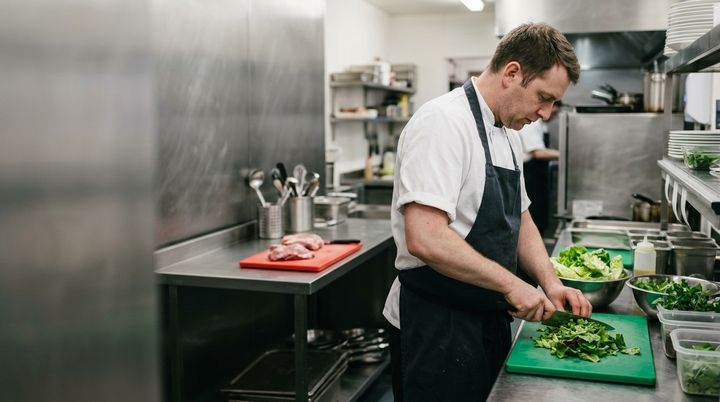
Cross Contamination
Cross contamination: the four routes and how to stop them in a kitchen

Liam Jones

Founder of Pilla
Date Modified
22 November 2026


Date modified: 22nd November 2026 | This article has been written by Pilla Founder, Liam Jones, click to email Liam directly, he reads every email.
How bacteria and allergens get from raw food onto ready-to-eat food, the four routes they take, and the separation, cleaning and handwashing habits that stop them.
Article Content
Cross contamination is when harmful bacteria, viruses or allergens pass onto food from other food, surfaces, hands or equipment. In a kitchen it usually means bacteria from raw food ending up on food that won't be cooked again, where nothing will kill them before someone eats it.
Cross contamination at a glance
- Raw food touching or dripping onto ready-to-eat food is the main risk. See the four routes below.
- Keep raw and ready-to-eat food, kit and surfaces apart. Colour-coded boards are the usual way to show it, not the only way.
- Complex equipment like vac packers and slicers can't be shared between raw and cooked food unless it's fully taken apart and disinfected.
- Gloves and hand gels don't replace handwashing, and raw meat and poultry shouldn't be washed.
- Allergens spread the same way, and cooking doesn't remove them.
What is cross contamination?
The UK government's guide to avoiding cross-contamination in your food business gives the short version: "Cross-contamination is when bacteria is spread between food, surfaces or equipment." The Food Standards Agency's Safer Food Better Business pack widens that to allergens and calls it "one of the most common causes of food poisoning".
Picture it on a busy lunch shift. Raw chicken juice on a salad board. A knife used on raw beef, wiped and then used on cooked ham. A chef handles raw mince, then plates a dessert. Cooking would have killed the bacteria on the raw food. Nothing kills them once they're on the ready-to-eat food.
Why it matters: raw food, ready-to-eat food and low doses
The guidance splits food into two groups.
- Raw food needs cooking or washing before it's safe. SFBB lists "raw meats & unwashed salad, vegetables and fruits".
- Ready-to-eat food won't be cooked again before it's eaten: "cooked foods, washed salads, garnishes, desserts and other foods that will not be cooked before eating" (SFBB separating foods).
GOV.UK says the harmful kind "is most likely to happen when raw food touches or drips onto ready-to-eat food, utensils or surfaces". The risk is greatest with E. coli O157, which the Food Standards Agency (FSA) says "can cause infections in very low doses - less than 10 bacteria" (FSA E. coli O157 cross-contamination guidance). It also survives the fridge and the freezer. At that dose, a smear you can't see is enough. Cooking won't save the salad.
The four routes, and the control for each
The table below is how we'd map routes to controls for a typical pub or restaurant kitchen. The controls come from the FSA and Food Standards Scotland (FSS) guidance cited throughout this page.
| Route | Kitchen example | Main control | Check it with |
|---|---|---|---|
| Food to food | Raw meat stored above cooked food; blood drips onto a dessert | Raw below ready-to-eat, covered, or in a separate fridge | Fridge layout check at opening |
| Surface and equipment | Same board, knife, slicer or vac packer for raw and cooked | Separate equipment, or full clean and disinfection between uses | Colour code or labels; cleaning schedule |
| Hands | Handling raw chicken, then plating salad | Handwashing after raw food and before ready-to-eat food | Sinks stocked; training record |
| Indirect touch points | Door handles, tills, phones, bin lids, cloths | Clean them on the schedule; single-use cloths | Cleaning sign-off |
Allergens follow the same four routes. We cover them in their own section below because the controls work a bit differently.
Separation: what the guidance expects
The FSA ranks the ways of keeping raw and ready-to-eat food apart. "The options in order of effectiveness are":
- A permanent separate room for raw food, with its own storage, staff, equipment, utensils and sinks.
- A permanent "clean area" for ready-to-eat food, big enough and far enough from raw work that splashes can't reach it.
- A "temporary clean area" that is separated by time, cleaned and disinfected between uses.
Most small kitchens use option 3. If you do, the FSA wants it planned: "all ready-to-eat food should be prepared first and either served for immediate consumption or chilled/stored", then the area is used for raw meat, then cleaned and disinfected again.
Where you share space, the FSA lists what to split or mark as raw or ready-to-eat. That includes fridges, utensils, sinks, wash hand basins, and even "cling film, wrapping (and dispensers), vac bags, sanitiser, cloths".
Storage
GOV.UK's rule is short: "store raw food below ready-to-eat food in the fridge". The FSA guidance adds the exception: raw food "must be stored below ready-to-eat food unless other measures are in place to ensure that cross-contamination is avoided". The ideal is separate fridges. If you share one, SFBB says raw meat, poultry, fish and eggs go at the bottom. Unwashed fruit and vegetables go above raw meat and away from ready-to-eat food. For the temperatures, see our fridge temperature guide.
Watch for two storage problems.
- Defrosting. SFBB warns that the liquid from defrosting raw food "can contain harmful bacteria". Defrost covered, in the fridge, below ready-to-eat food.
- Clean kit stored in a raw area. The FSA says equipment and wrapping for ready-to-eat food must not be stored "underneath a worktop where preparation of raw food is undertaken".
Complex equipment
Vacuum packers, slicers, mincers, blenders and mixers "are not to be dual used unless the equipment is fully dismantled and disinfected between uses". Bacteria get into internal parts that routine cleaning doesn't reach.
In practice, that means one vac packer or slicer for raw and another for cooked. Label them. If a supplier sells "vac-packed" cooked meats, ask how they handle this. FSS uses almost the same wording ("unless the equipment is fully dismantled and disinfected between uses"), and CookSafe calls dual use of complex equipment "particularly dangerous".
Sinks
Don't wash ready-to-eat food in a sink used for raw food unless it has been cleaned and disinfected. Even then, the FSA says ready-to-eat food "must not come into direct contact with the sink"; use a dedicated container. The FSA recommends separate sinks where you can manage it.
Colour-coded chopping boards: do you need them?
Not always. What matters is that raw and ready-to-eat equipment stays apart, and colour is the easiest way to show it. The FSA calls dedicated equipment good practice. It says businesses should have separate knives, containers and chopping boards for raw and ready-to-eat food, and "these should be easily identifiable, for example, colour coded". It also says: "Where heat disinfection or dishwasher cleaning is not available this is essential."
If you have a commercial dishwasher that can heat disinfect, the same guidance says you can use the same equipment, as long as it goes through that cycle between raw and ready-to-eat use. If you don't, you need dedicated, clearly marked kit.
A common scheme is:
| Colour | Use |
|---|---|
| Red | Raw meat |
| Blue | Raw fish |
| Yellow | Cooked meat |
| Green | Salad and fruit |
| Brown | Raw vegetables |
| White | Bread and dairy |
Some caterers add purple for allergen-free food. These colours are an industry convention, not something any food regulator sets, and schemes vary between countries and suppliers. Keith Warren of the catering equipment suppliers' association CESA told The Staff Canteen: "it is not a regulation that you have to use a particular colour with a particular food product" (The Staff Canteen).
But sticking to the standard colours still helps. New staff arrive knowing them, and a red board used for cooked chicken is a mistake waiting to happen. Whatever scheme you use, write it in your food safety plan and put a chart on the wall.
Also replace worn boards. The FSA says "Chopping boards that have deep scores from repeated use should be replaced as effective cleaning may no longer be possible."
Cleaning and disinfection
Separation only works if the cleaning between uses works. The FSA guidance asks for:
- A two-stage clean: clean off the dirt first, then disinfect. Disinfectant doesn't work on a dirty surface. Our two-stage cleaning page covers the method.
- Products tested to a recognised disinfection standard, such as the European BS EN 1276 or BS EN 13697. It's on the label or the data sheet.
- The right dilution and contact time. The guidance warns disinfectants "will not be effective if used on dirty surfaces, or if applied at the incorrect dilution or for the insufficient contact time".
- Heat disinfection, such as a commercial dishwasher cycle, as the alternative to chemicals for utensils and boards.
Cloths. CookSafe says cloths "must be kept clean" and suggests single-use cloths for "light switches, door handles and telephones". A reused cloth wiped across a raw-meat bench and then a serving counter spreads bacteria across the whole kitchen.
Touch points. GOV.UK names "door handles, bins, tills and touch screen electronics". The FSA says shared items like "pens, phones, chip and pin machines and light switches" can be shared by raw and ready-to-eat staff. If they are, "Staff must wash their hands before handling any ready-to-eat food and after handling raw food. This is the main control."
Hands, gloves and gels
For hands, the rule is to wash after touching raw food, bins, money or your phone, and before touching ready-to-eat food. CookSafe sets out the steps: wet your hands, apply liquid soap, rub palm to palm, the backs of the hands and between the fingers, then rinse and dry "with a single use towel".
The FSA guidance is firm on gloves and gels.
- Gloves. "Gloves are not a substitute for effective handwashing." Change them as often as you'd wash your hands, wash before putting them on, and change any that tear. And one pair of gloves worn from the raw-chicken prep to the salad station is no better than not washing at all.
- Hand gels. The FSA says they "do not remove visible dirt and are not to be used as a replacement for handwashing". Use them after washing if you like, never instead of it.
Don't wash raw meat or poultry
Plenty of cooks were taught to rinse chicken. Don't. SFBB says plainly "Do not wash raw meat or poultry" because washing "does not kill bacteria", and it "can splash harmful bacteria around the kitchen contaminating sinks". GOV.UK lists "not washing raw meat, fish and poultry" as one of its controls. Cooking does the job.
Allergen cross-contact
Allergens spread the same way. When one gets into a dish that should be free of it, the result for someone with a severe allergy can be fatal. Many allergen specialists call this "cross-contact", because cooking doesn't remove an allergen the way it kills bacteria.
The routes are the same: shared fryer oil, a spoon moved from the satay to the stir-fry, flour dust settling in the open, a board that held bread and then cheese for a gluten-free order. The controls are:
- Prepare allergen-free food separately "where possible" and store it separately (SFBB).
- Use dedicated or freshly cleaned equipment. Cleaning removes allergen traces. Heat doesn't.
- Wash hands and change aprons between tasks.
- Keep the allergen information for each dish accurate, and update it when a recipe or supplier changes.
"May contain" labels. If you pre-pack food for sale, the FSA's precautionary allergen labelling guidance says a label like "may contain x" "should only be used when, following a risk assessment, a risk of allergen cross-contact within the supply chain is identified that cannot be removed through risk management actions". Blanket wording such as "may contain allergens" "could be deemed misleading". And you can't put "may contain milk" on something you also call "free-from milk".
For training your team, see our allergen management guide.
Physical and chemical contamination
SFBB also covers the other two kinds of contamination. Physical contamination is anything that ends up in food by accident: glass, metal, plastic, hair, plasters. That's why SFBB asks for cuts to be covered with "a brightly coloured waterproof dressing". Chemical contamination means things like "cleaning products or pest control chemicals". SFBB says to store cleaning chemicals "separately from food", label them clearly and follow the manufacturer's instructions. They're separate hazards from bacterial cross-contamination, but your HACCP plan needs to cover all three.
E. coli O157: the case for strict separation
The FSA says E. coli O157 "mostly live in the intestines of animals", and because animals live in fields, soil can carry it too. That puts it on raw meat and on unwashed vegetables. The dose is tiny, and the FSA says "special care" is needed where young children or the elderly are the main customers, such as schools and care homes. That's why the guidance is stricter on complex equipment and separation than general hygiene advice. CookSafe says staff with E. coli O157 need "formal exclusion and then medical clearance" before they go back to handling food.
If you sell raw and ready-to-eat food from the same counter, as many butchers, delis and farm shops do, read the FSA's E. coli O157 cross-contamination guidance in full. For staff training, see our E. coli control training guide.
How to check your kitchen in ten minutes
Walk the kitchen with this list at opening:
- Fridges: raw food at the bottom, covered and labelled; nothing defrosting on an open shelf.
- Boards and knives: right colour (or right label) at each station; no deep scores.
- Complex equipment: slicer and vac packer marked raw or cooked, and used that way.
- Sinks: soap, hot water and paper towels at every wash hand basin.
- Cloths: fresh or single-use; none left on a raw bench.
- Sanitiser: in date, tested to a recognised disinfection standard, at the right dilution.
- Allergen-free station and containers set up; allergen chart current.
- Touch points (doors, tills, phones) on today's cleaning schedule.
Record it. A dated record of these checks shows an inspector, or a customer who complains, that the controls happen every day. You can run the same list as a digital checklist in Pilla, with photos and a sign-off at each station.
Common myths
"Colour-coded boards are what keeps you safe." Separation is what keeps you safe. Colour is the usual way to show it. Without dishwasher heat disinfection, the FSA says dedicated equipment is "essential".
"Gloves mean you don't need to wash your hands." The FSA says the opposite: "Gloves are not a substitute for effective handwashing."
"Hand gel does the same job." It doesn't replace washing with soap and water.
"Washing chicken makes it safer." It spreads bacteria round the sink. Cook it properly instead.
"A good wipe is enough for the slicer." Not for complex equipment used for raw and cooked food. It has to be fully dismantled and disinfected, or kept for one use only.
"Cooking kills allergens." It doesn't. Allergen control relies on separation and cleaning.
Rules where you are
The food hygiene rules on preventing contamination, and how they're enforced, differ by country. These regulators keep their own pages up to date, so check yours:
- England, Wales and Northern Ireland: the Food Standards Agency, avoiding cross-contamination in your food business
- Scotland: Food Standards Scotland, E. coli O157 control of cross-contamination
- Ireland: the Food Safety Authority of Ireland, prerequisite programmes
- United States: the FDA Food Code, adopted state by state: the FDA's state retail and food service codes
- Canada: the Canadian Food Inspection Agency, preventing cross-contamination, plus your provincial food premises rules
- Australia: Food Standards Australia New Zealand, Safe Food Australia, a guide to the food safety standards
- New Zealand: the Ministry for Primary Industries, food control plans
FAQ
What is cross contamination in food?
It's when harmful bacteria, viruses or allergens spread onto food from other food, surfaces, hands or equipment. The most dangerous kind is when bacteria from raw food reach food that won't be cooked again.
What are the main types of cross contamination?
Food to food (raw meat dripping onto cooked food), surfaces and equipment (shared boards, knives or slicers), hands, and indirect touch points like door handles, tills and cloths. Allergens spread by the same routes. Physical and chemical contamination are related hazards.
Do I need colour-coded chopping boards?
You need raw and ready-to-eat equipment kept apart. Colour coding is the usual way to do it. The FSA calls dedicated, identifiable equipment good practice, and essential if you can't heat disinfect it in a dishwasher.
Where should raw meat go in the fridge?
At the bottom, covered, below ready-to-eat food. Ideally use a separate fridge for raw meat.
Can I use the same vacuum packer for raw and cooked food?
Only if it's fully dismantled and disinfected between uses, which few kitchens can manage. The FSA says complex equipment should not be dual used otherwise.
Do gloves prevent cross contamination?
Only if they're changed as often as you'd wash your hands. The FSA says gloves are not a substitute for handwashing.
What is allergen cross-contact?
It's when an allergen gets into food that should be free from it, for example through a shared fryer, utensil or board. Cooking doesn't remove allergens, so separation and cleaning are the controls.