Traceability
What is food traceability? One step back, one step forward, and why it makes a recall work

Liam Jones

Founder of Pilla
Date Modified
22 November 2026


Date modified: 22nd November 2026 | This article has been written by Pilla Founder, Liam Jones, click to email Liam directly, he reads every email.
Food traceability means knowing where your food came from and where it went. Here is what one step back and one step forward means, which records to keep at delivery and in the kitchen, and how it makes a recall or withdrawal work.
Article Content
Food traceability means being able to say where a food came from and where it went. In practice that's usually described as one step back and one step forward: you know which supplier sold you each product, and you know which businesses you sold it on to. Many businesses go further and track batches through their own kitchen too, so they know which deliveries went into which dishes.
You don't notice traceability until you need it. Then you need it fast. When a supplier rings to say a batch of cream cheese may carry listeria, the question is simple: did we get that batch, where is it now, and what did we make with it? A business with good records can answer in ten minutes. Without them, it bins everything and hopes.
Traceability at a glance
- One step back: know who supplied each product, what it was and when it arrived.
- One step forward: know which businesses you supplied, if you sell to other businesses.
- Batch or lot codes are what make traceability precise. Record them at delivery.
- Internal traceability links deliveries to what you made with them. It's what turns a big recall into a small one.
- It makes recalls and withdrawals work, so unsafe food comes off shelves and plates quickly.
- Test it with a practice run before you need it for real.
What it is, and why it matters
Food moves through a long chain: farm, processor, wholesaler, distributor, kitchen or shop, customer. When something goes wrong at any point, such as contamination, a wrong label or an undeclared allergen, the food has to be found and pulled back out of that chain. Traceability is the record that lets every business in the chain do its part.
One step back, one step forward
| Direction | What you need to know | Where it comes from |
|---|---|---|
| One step back | Supplier name and contact, what you received, how much, the date, and the batch, lot or use-by code | Delivery notes, invoices, your delivery check |
| Internal | Which deliveries went into which dishes or products, when | Prep labels, batch sheets, cooking and cooling records |
| One step forward | Which businesses you supplied, what, how much, when | Invoices, delivery notes, order records |
Restaurants, cafés and shops that sell straight to the public don't usually need to record which individual customers bought what. Caterers supplying other businesses, wholesalers and manufacturers do need the step forward.
Withdrawals and recalls
When unsafe food has to come out of the chain, there are two levels:
- A withdrawal takes the product off the market before it reaches consumers, or back from other businesses.
- A recall reaches consumers too, usually with notices in shops and public alerts.
Either way, every business that bought the product needs to find it, stop using it, set it aside and follow the instructions. Our product recall procedure sets out the steps.
A worked example
A bakery café gets an alert from its dairy supplier: one batch of double cream may contain foreign bodies. The alert gives the batch code and use-by date.
The manager checks the food delivery check records. They received two cases of that batch on Tuesday. One case is unopened in the walk-in. The other was opened on Wednesday. Prep labels show it went into two batches of whipped cream and a tray of cheesecakes, all still in the fridge.
Within twenty minutes, the unopened case is set aside, the whipped cream and cheesecakes are labelled "Do not use" and logged, and the supplier is told what's been quarantined. Nothing made with that batch has been sold. Without the batch code on the delivery record and the dates on the prep labels, the café would have had to bin all its cream and cream products for the week.
How it works in practice
At delivery
The step back starts at the back door. For every delivery, record:
- The supplier
- Each product and quantity
- The batch or lot code, and the use-by or best before date
- The date and time it arrived
- Who checked it in
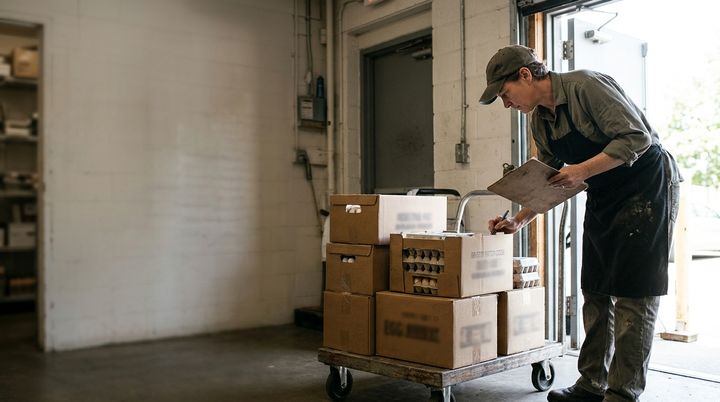
Keep the delivery note or invoice too. A photo of the label on each case is quick and catches the batch code without anyone writing it out. Our delivery received check builds this into the delivery routine. Buying only from approved suppliers helps too, because a supplier with good records of their own can tell you quickly what's affected.
In the kitchen
Internal traceability doesn't have to be complicated:
- Keep products in their original packaging where you can, so the label stays with the food.
- When you decant, copy the product name, batch code and date onto the new container's label. Our date labelling guide has examples.
- Label prepared food with the date it was made. For larger batches, note the main ingredients' batch codes on the label or a batch sheet.
- Keep cooking, cooling and hot holding temperature records with dates, so you can tell when a batch was made and served.
Selling on
If you supply other businesses, keep a record of who you sold what to, when, and how much, with batch codes where you can. That's your step forward.
How long to keep records
Keep traceability records for at least as long as the food could be in use or in someone's cupboard, and usually longer. How long exactly is set by the rules where you are.
Practise
A traceability system that's never been tested might not work. Every so often, pick a product from a recent delivery and try to trace it: which delivery, which batch, where it is now, and what was made with it. Time how long it takes. If it's slow or you can't finish, fix the gap. Many businesses do this once or twice a year as a mock recall.
When something goes wrong
Traceability isn't only for supplier recalls. If a customer complains about something in a dish, or you find a problem yourself, such as a near miss with an allergen, your records help you work out which batch was involved and whether anything else is affected.
Where it fits
Traceability is part of your food safety management system, alongside HACCP and the records that show due diligence. It uses many of the same records you already keep for other reasons: delivery checks, date labels, and cooked food temperature records. The work is mostly making sure batch codes and dates are captured and kept together.
Common mistakes and myths
| What people say | What's actually true |
|---|---|
| "The invoice is enough" | Invoices often don't show batch codes. Record them at delivery |
| "We only sell to the public, so it doesn't apply" | You still need the step back, to know what you bought and from whom |
| "We decant everything, so labels go in the bin" | Copy the batch and date onto the new label first |
| "The supplier will know what we got" | They know what they sent. You need to know where it went in your kitchen |
| "We'll sort it if there's ever a recall" | In a recall, there's no time to rebuild records. Test it in advance |
| "Traceability is only for manufacturers" | Every food business needs at least the step back |
Rules where you are
What traceability records food businesses must keep, for how long, and what to do in a withdrawal or recall differ by country. These regulators keep their own pages up to date, so check yours:
- England, Wales and Northern Ireland: the Food Standards Agency, food incidents, product withdrawals and recalls
- Scotland: Food Standards Scotland, food traceability guide
- Ireland: the Food Safety Authority of Ireland, traceability
- United States: the Food and Drug Administration, the food traceability rule
- Canada: the Canadian Food Inspection Agency, traceability for food
- Australia: Food Standards Australia New Zealand, food recall requirements
- New Zealand: the Ministry for Primary Industries, how to do a simulated food recall
FAQ
What is food traceability?
Being able to say where a food came from and where it went. It usually means knowing which supplier sold you each product and, if you sell to other businesses, who you sold it on to.
What does one step back, one step forward mean?
One step back means knowing who supplied you. One step forward means knowing which businesses you supplied. Together, they let every business in the chain find a product quickly in a recall.
What records do I need for traceability?
For each delivery: the supplier, the product, the quantity, the batch or lot code, the date and who checked it in. If you supply other businesses, keep the same details for what you sell on.
What is the difference between a withdrawal and a recall?
A withdrawal takes food off the market before it reaches consumers. A recall reaches consumers too, usually with public notices asking them to return or throw away the product.
How do I test my traceability?
Pick a product from a recent delivery and trace it: find the delivery record, the batch code, where the rest of it is now, and what was made with it. Time how long it takes and fix any gaps.