Goods Received Note
What is a goods received note? What it records and how it stops you paying for what never arrived

Liam Jones

Founder of Pilla
Date Modified
22 November 2026


Date modified: 22nd November 2026 | This article has been written by Pilla Founder, Liam Jones, click to email Liam directly, he reads every email.
A goods received note is your own record of what actually arrived in a delivery: what, how much, what condition and who checked it. Here is how it differs from a delivery note and an invoice, how three-way matching works and how to handle shortages.
Article Content
A goods received note, or GRN, is a record a business makes when a delivery arrives, showing what was actually received: which items, how many, in what condition, on what date, and who checked them in. It's your own record, not the supplier's. Its main job is simple: to make sure you only pay for what you actually got.
Without one, the invoice becomes the only record of what arrived, and the invoice is written by the supplier. Short deliveries, damaged items, wrong products and substitutions all slip through, and a few missing cases a week adds up to real money over a year.
Goods received notes at a glance
- A GRN records what actually arrived, checked against what was ordered.
- It's made by you, at the point of delivery, by whoever checks it in.
- It's not the same as a delivery note, which is the supplier's list of what they say they sent.
- Three-way matching compares the purchase order, the GRN and the invoice before paying.
- Shortages, damages and substitutions go on the GRN, so you can claim a credit.
- For food deliveries, it sits alongside the safety checks: temperatures, dates and condition.
What it is, and why it matters
The documents in a purchase
| Document | Who makes it | What it says |
|---|---|---|
| Purchase order | You | What you've asked for, how much, at what price |
| Delivery note | The supplier | What they say is in the delivery |
| Goods received note | You | What actually arrived, and its condition |
| Invoice | The supplier | What they're asking you to pay |
| Credit note | The supplier | What they're taking off, for shortages, damages or returns |
In a small business, the GRN is often the supplier's delivery note, checked and annotated by the person receiving it: ticks against items received, quantities corrected, damages noted, signed and dated. That works, as long as it's done properly every time. Larger businesses often record it in a stock or purchasing system.
Three-way matching
Before an invoice is paid, someone compares three things:
- The purchase order: what did we order, and at what price?
- The GRN: what did we actually receive?
- The invoice: what are we being charged for?
If all three agree, the invoice is paid. If they don't, the difference is chased before payment: a missing case, a wrong price, a substituted product, or a charge for something that was sent back. This is how businesses stop paying for goods that never arrived.
A worked example
A restaurant group orders 20 cases of chicken thighs, 10 cases of salmon and 12 trays of eggs from its wholesaler for one site. The delivery driver is in a hurry, and the kitchen porter signs the delivery note without counting.
At the end of the month, the finance team does a three-way match and finds the site's invoice charges for 20 cases of thighs, but only 18 went into the stock count. Nobody can prove it, because the delivery note was signed as received in full. The site has paid for two cases it can't find.
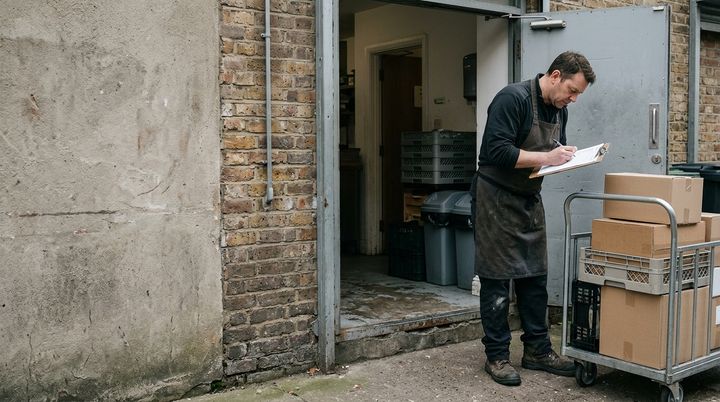
The fix is a proper GRN at the back door. Now the person receiving each delivery counts it against the order, notes any shortages or damage on the delivery note or in the delivery received check, takes a photo, signs it, and the supplier is told the same day. The next short delivery is credited within the week.
How it works in practice
Receiving a delivery
- Check you're expecting it, against an open purchase order. Our purchase requisition workflow keeps orders in one place.
- Count every item against the order and the delivery note. Count cases and, for high-value items, units inside the case.
- Check condition: damaged packaging, broken items, leaks, dents.
- Check it's the right product, brand, size and specification. Note any substitutions.
- For food, do the safety checks: chilled and frozen temperatures, use-by dates, signs of pests, packaging intact. Our food delivery check covers these, and our guide to traceability explains why batch codes matter.
- Refuse anything unsafe or wrong, and note it.
- Record it: what was received, quantities, problems, the date and time, and your name.
- Ask the driver to sign any notes about shortages or refusals, if your supplier's process allows.
- Put the stock away promptly, chilled and frozen first.
What goes on a GRN
| Field | Why it's there |
|---|---|
| Supplier | Who it came from |
| Date and time | When it arrived |
| Purchase order or reference | Links it to what was ordered |
| Items and quantities received | What actually arrived |
| Shortages, damages, refusals and substitutions | What to claim credit for |
| Condition and safety checks, for food | Temperatures, dates, condition |
| Received by | Who checked it in |
| Photos | Evidence for any dispute |
After the delivery
- Send the GRN, or the annotated delivery note, to whoever pays invoices.
- Tell the supplier about shortages or damage the same day, and ask for a credit note.
- Match the purchase order, GRN and invoice before paying.
- Keep the GRN with the invoice for your records.
Spotting patterns
Over time, your GRNs show which suppliers deliver short or late, which products often arrive damaged, and which drivers rush the check. That's useful when you review your approved suppliers. Differences between what GRNs say arrived and what your stock counts find point to losses somewhere else, which is what a stock reconciliation looks into.
Common mistakes and myths
| What people say | What's actually true |
|---|---|
| "The driver's in a hurry, just sign it" | Signing for a full delivery without checking means you can't claim for shortages |
| "The invoice tells us what we got" | The invoice says what you're being charged for. The GRN says what arrived |
| "We'll check it when we unpack" | By then nobody can prove it was short on arrival |
| "Substitutions are fine" | A different product can change the price, the recipe and the allergens. Note it and check |
| "Small shortages aren't worth chasing" | A few missing items every delivery add up over a year |
| "Only big businesses need GRNs" | Any business that pays invoices benefits from knowing what actually arrived |
Rules where you are
There's no law about the goods received note itself, but rules on keeping purchase records for tax, and how long to keep them, differ by country. These tax authorities keep their own pages up to date, so check yours:
- United Kingdom: GOV.UK, company and accounting records and business records if you're self-employed
- Ireland: Revenue, keeping records
- United States: the Internal Revenue Service, what kind of records should I keep
- Canada: the Canada Revenue Agency, business records
- Australia: the Australian Taxation Office, record-keeping rules for business
- New Zealand: Inland Revenue, record keeping
FAQ
What is a goods received note?
A record made when a delivery arrives, showing what was actually received: the items, quantities, condition, date and who checked it in. It's used to make sure you only pay for what you got.
What is the difference between a delivery note and a goods received note?
A delivery note is the supplier's list of what they say they've sent. A goods received note is your own record of what actually arrived, after checking. Many small businesses annotate and sign the delivery note to use it as their GRN.
What is three-way matching?
Comparing the purchase order, the goods received note and the invoice before paying. If all three agree, the invoice is paid. If not, the difference is sorted out with the supplier first.
What should I do if a delivery is short?
Note the shortage on the GRN or delivery note, take a photo if it helps, ask the driver to sign the note if you can, and tell the supplier the same day. Ask for a credit note and don't pay for the missing items.
Who should fill in a goods received note?
Whoever receives the delivery, as long as they've been shown how to check it properly. They should count it, check its condition, note any problems and sign it.