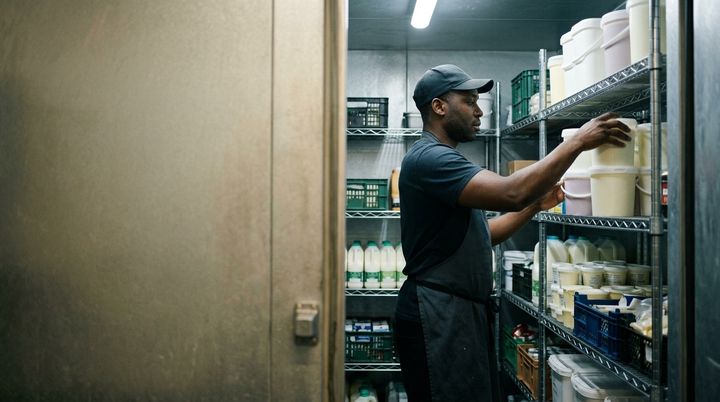
FIFO Stock Rotation
FIFO stock rotation: what it means, FIFO vs FEFO and how to do it

Liam Jones

Founder of Pilla
Date Modified
22 November 2026


Date modified: 22nd November 2026 | This article has been written by Pilla Founder, Liam Jones, click to email Liam directly, he reads every email.
FIFO stock rotation means using your oldest stock first so nothing passes its date. Here is how it works, when FEFO is the better rule, use-by vs best before, freezing, labels and a routine your team can follow.
Article Content
FIFO stock rotation (first in, first out) means using your oldest stock before your newest, so food gets used while it's still in date. New deliveries go to the back, older stock comes to the front, and nothing sits forgotten until it has to be thrown away.
FIFO stock rotation at a glance
- FIFO is a habit, not a rule written on a label. What it protects is the date on the pack.
- FEFO (first expired, first out) is the better rule when a newer delivery carries an earlier date. Go by the date, not the delivery day.
- A use-by date is about safety and a best before date is about quality, so use-by food is the stock that matters most.
- Food you freeze before its use-by date needs a "date frozen" label, or nobody can tell later whether it went in on time.
- Decanted and opened food needs your own label, because the maker's label stays on the empty pack.
- The easiest rotation is less stock: order against what you've counted.
What is FIFO stock rotation?
FIFO means the stock that came in first goes out first. When a delivery arrives, the new stock goes to the back of the shelf or the bottom of the pile, and the older stock moves to the front where people grab it. The Food Standards Agency's Safer food, better business stock control sheet puts it simply: "Follow the 'first in, first out' system of stock rotation, so that older stock is used first. This helps to avoid waste."
Food Standards Scotland's CookSafe guidance describes the wider job as "the measures taken to ensure that food is not kept beyond its shelf life." Rotation is the part of that job your team does every time a delivery comes in.
It matters for two reasons. Food used in date is safer, and food used before it goes off isn't money in the bin. In a busy kitchen, a crate of cream that gets pushed to the back for a week can cost more than the time it takes to rotate every delivery properly.
FIFO vs FEFO
FEFO means first expired, first out. You use whatever has the earliest date, whenever it arrived. Most of the time FIFO and FEFO give the same answer, because older stock usually has the earlier date. They split when a newer delivery has a shorter date than what's already on the shelf. That happens with a different supplier, a short-dated batch, or stock moved over from another site.
When that happens, go by the date. A FIFO rule followed blindly can leave in-date new stock in use while older, shorter-dated stock runs out of date at the back. A food safety manager on the IFSQN forum put it well back in 2011: "You should not follow FIFO blindly but have responsibilities and a defined system for checking codes on stock coming in and stock going out".
So FIFO is the habit, and the date is what you check.
Which item do I use first?
| Situation | Use first | Why |
|---|---|---|
| Same product, same date, two deliveries | The one that arrived first | Plain FIFO |
| Same product, newer delivery has the earlier date | The earlier date | FEFO: the date is what matters |
| One has a use-by, the other a best before | The use-by item, if it's close | Use-by is about safety, best before about quality |
| Item is on its use-by date today | Use it today or bin it at close | The use-by day is the last day |
| Food you froze before its use-by | The oldest "date frozen" label | Without a label you can't tell when it went in |
| Opened or decanted food | The earliest date on your own label | The maker's date may no longer apply once opened |
| Dry goods in a tub | Finish the tub, then refill it | Topping up mixes old and new |
Use-by vs best before
The two dates look alike and mean different things. The FSA's guide to best before and use-by dates sums it up: use-by is about safety, best before is about quality. Many countries use the same two marks, though not all, and each country sets its own rules on what can be sold after each date.
| Date mark | What it means | What it means for rotation |
|---|---|---|
| Use by | Safety. Food can be unsafe after this date even if it looks and smells fine | Check these every day. They go first, and they go in the bin at close on the day |
| Best before | Quality. The food may be past its best | Still rotate it. A dented can or a damp bag of rice can spoil before its date |
| Frozen on | The date you froze the food | A record, not a deadline. It shows when the food went in |
Best before food is usually frozen, dried or tinned stuff, plus hard cheese. It feels safe to leave at the back, which is exactly why it gets forgotten.
Can you freeze food before its use-by date?
Usually, yes. Freezing pauses the clock, so most food safety bodies say you can freeze food on or before its use-by date and use it later. Once defrosted, use it within a day.
The catch is proof. A frozen chicken breast with a use-by date that's gone looks the same whether it went in the freezer on time or a week late. A "date frozen" label is the only way anyone can tell. The FSA's stock control sheet says why it matters for rotation too: "If labelling is not clear on frozen food, new stock might be used before old stock."
How to rotate stock, step by step
At delivery
Rotation starts at the back door. If stock's already a problem when it arrives, don't sign for it. Check that each item is in date, has been kept cold enough, hasn't gone off and isn't damaged: punctured vacuum packs, swollen packs and badly dented cans go back. There's more on this in our food delivery check guide.
Putting it away
- Put chilled and frozen stock away first.
- Pull the old stock forward.
- Put the new stock behind or under it. Never on top.
- Where dates differ from what you'd expect, put the earliest date at the front.
- Move damaged stock out of the main store.
Fridges and walk-ins
Chilled food is where use-by dates sit, so it's where rotation matters most. Keep one product type together so the dates sit side by side. Make your own prepared food follow the same rule, with a label and a short life. Our safe food storage guide covers the shelf order.
Freezers
Label everything you freeze with the date it went in. Keep the oldest labels at the top or front. Once a month, go through the freezer for unlabelled bags. Those are the ones nobody can vouch for. There's more in our freezer temperature check guide.
Dry stores
Don't top up. Finish the tub, clean it and then refill it. Topping up mixes old and new, and a tub that never empties never gets cleaned.
Order less
Honestly, the easiest fix is to hold less stock. Do a stock count before you order, and order against what you've actually got. If you've over-ordered something perishable, freeze some of it early, following the maker's instructions.
Labelling decanted, opened and prepared food
Once food leaves its pack, the maker's label goes with it, and so does the date. When you move food into another container, write down what it is, its ingredients and its date.
Many packs also say "once opened, use within X days", and that new date can come before the printed one. Use whichever is sooner.
A workable label has:
- what it is
- the date made, opened or defrosted
- the use-by date you've worked out
- who did it
Our date labelling guide has examples.
Allergens in stock control
Allergen mistakes often start in the store room. If you decant food, you lose the ingredients list unless you copy it onto the new label.
Running out causes a second risk. When a product runs out and someone grabs a substitute, the allergens can change. A replacement brand of pesto, stock cube or bread can contain nuts, milk or sesame that the old one didn't. Check the new label and tell front of house before service. Our allergen management guide covers the allergen matrix.
What records are worth keeping?
Rotation happens in seconds and leaves no trace, so a record is the only way to show it's happening. A good set shows:
- delivery checks, including rejected items
- a daily date check, often at close
- what you threw away and why
- freezer labels with the date frozen
- staff trained on rotation, with dates
The waste log pays for itself. If the same product keeps getting binned, you're ordering too much of it. Our stock rotation training checklist gives you a ready agenda and a sign-off sheet for the training.
Common mistakes and myths
| What people say | What's actually true |
|---|---|
| "FIFO means soonest date at the front" | That's FEFO. FIFO goes by arrival, FEFO by date. Use FEFO when they disagree |
| "Use by means it's rotten" | Use-by is a safety date. Food can be unsafe after it without looking or smelling off |
| "It's fine if it smells OK" | Not for a use-by item. The bacteria that make people ill often don't change the smell |
| "Best before means bin it" | Best before is about quality. Rotate it, check its condition, and use it |
| "I froze it, so the date doesn't matter" | Only if it went in on or before the use-by, and the label shows when |
| "Just write the purchase date on it" | A purchase date isn't a use-by. Keep the maker's date with the food |
| "Top up the flour tub" | Finish it, clean it, refill it |
Some of these come from real posts. One X user wrote: "We generally ignore the 'use by' date. Instead, we mark the item by adding the month/year we purchased the item, then practice FIFO…" That may work in a home pantry. In a business it loses the one date that counts.
FIFO in accounting: the other meaning
Search "FIFO" and you'll mostly find accountants. In stock valuation, FIFO is an assumption about which costs went out, not about which tins left the shelf: the stock you still hold is valued at the cost of the most recent deliveries.
The two meanings meet in your stock count. If you rotate properly, your physical stock really is the newest stock, so FIFO valuation matches what's on the shelves. FIFO also turns up in computing (a queue) and remote-site jobs (fly-in, fly-out). Neither has anything to do with your walk-in.
Rules where you are
The rules on date marks, and on what can be sold after each date, differ by country. These regulators keep their own pages up to date, so check yours:
- England, Wales and Northern Ireland: the Food Standards Agency, best before and use-by dates
- Scotland: Food Standards Scotland, use by and best before dates
- Ireland: the Food Safety Authority of Ireland, labelling requirements and shelf life
- United States: the USDA Food Safety and Inspection Service, food product dating
- Canada: the Canadian Food Inspection Agency, date markings and storage instructions
- Australia and New Zealand: Food Standards Australia New Zealand, food date labels
FAQ
What does FIFO mean in food?
First in, first out. Stock that arrived first is used first, so older food is used before it goes out of date and nothing gets forgotten at the back.
What is the difference between FIFO and FEFO?
FIFO uses stock in the order it arrived. FEFO (first expired, first out) uses the item with the earliest date first. When a newer delivery has a shorter date, use FEFO, because the date is what matters.
Can you use food on its use-by date?
Yes, up to the end of that day, if it's been stored as the label says. After that, throw it away. Many kitchens make it part of the closing check.
What does a best before date mean?
It's about quality, not safety. The food may be past its best after the date, but it can still be fine to eat if it's been stored properly and the pack is intact.
Can I freeze food on its use-by date?
Usually, on or before the date. Label it with the date it was frozen, so anyone can tell later when it went in. Once defrosted, use it within a day.
How often should I check dates?
Every day. Most kitchens check at delivery and at close, and write the checks down so they can see they happen. Our kitchen closing checklist includes the date check.