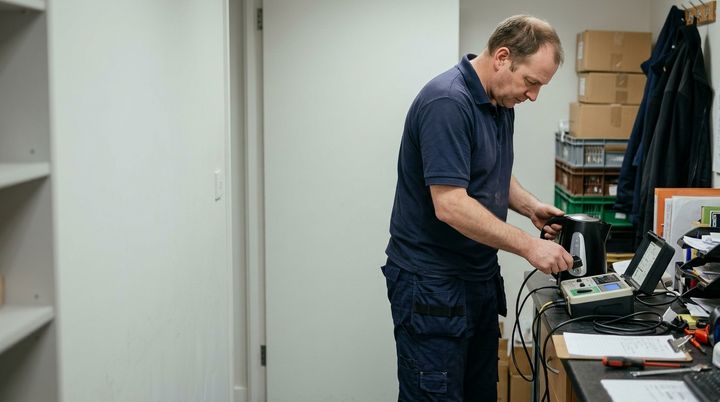
PAT Testing
PAT testing: what a portable appliance test checks and how it differs from a pre-use check

Liam Jones

Founder of Pilla
Date Modified
22 November 2026


Date modified: 22nd November 2026 | This article has been written by Pilla Founder, Liam Jones, click to email Liam directly, he reads every email.
PAT testing is the periodic inspection and testing of electrical equipment that plugs in. Here is what the test checks, how it differs from the quick look before use, how often kit needs testing, and what to do when something fails.
Article Content
PAT testing (portable appliance testing) is the periodic inspection, and where needed the electrical testing, of equipment that plugs into the mains: kettles, toasters, blenders, floor cleaners, laptop chargers, extension leads. In some countries it goes by "test and tag". The aim is simple: find the damaged plug, the frayed lead or the failing insulation before it gives someone a shock or starts a fire.
PAT testing is one layer of a bigger routine. The person using the kit checks it every time. Someone trained looks it over properly every so often. And a competent person tests it with a meter at intervals set by how hard the kit is used. Most faults are found by the first two layers, not the third.
PAT testing at a glance
- It covers anything with a plug, plus extension leads and chargers. Kit that's wired in is checked differently.
- There are three layers: the user's check before use, a formal visual inspection, and a combined inspection and test with a meter.
- How often depends on the risk. A floor polisher dragged round every night needs more attention than a desk lamp.
- Most faults are visible. Scorch marks, cracked casings, damaged leads and taped joins show up on a careful look.
- A sticker isn't a guarantee. It shows the kit passed on the day. Damage after that is caught by the user's check.
- Failed kit comes out of use straight away, labelled so nobody plugs it back in.
What it is, and why it matters
Electrical equipment fails in a few predictable ways. Leads get crushed under trolleys and pulled out by the cable. Plugs get cracked when they're dropped. Water gets into kit used near sinks. Inside, insulation breaks down with heat and age, and earth connections work loose. Some of these faults you can see. Some you can only find with a test.
The risk is higher in workplaces like kitchens, bars and cleaning teams, where kit is wet, hot, moved around and used hard. A blender on a steel counter next to a sink is a very different thing from a monitor on an office desk.
A worked example
A cleaning team uses six vacuum cleaners across three sites. During a pre-use check, a cleaner spots that the outer cover of one lead has split near the plug, showing the coloured wires inside. She doesn't use it. She tags it "Do not use", reports it, and takes a spare.
The supervisor checks the record. That vacuum passed its test four months ago. Nothing was wrong then; the lead was damaged since, probably shut in a door. The test didn't fail. The pre-use check did exactly what it's there for.
How it works in practice
The three layers
| Layer | Who does it | When | What it finds |
|---|---|---|---|
| User check | Whoever is about to use the kit | Every time, before use | Obvious damage: cracked plugs, cut or frayed leads, burn marks, loose parts, signs of water |
| Formal visual inspection | Someone trained to know what to look for | At set intervals | The above, plus wrong fuses, loose cable grips, signs of overheating, kit used where it shouldn't be |
| Combined inspection and test | A competent person with a tester | At longer intervals, based on risk | Hidden faults: broken earth connections, failing insulation, wiring faults in leads |
What the user check looks at
Train everyone to spend ten seconds on this before switching on:
- The plug is intact, with no cracks, bent pins or scorch marks.
- The lead is undamaged along its length, with no cuts, taped joins or exposed coloured wires.
- The outer cover of the lead is gripped where it enters the plug and the appliance, so no inner wires show.
- The casing has no cracks or missing parts, and nothing rattles loose.
- There's no sign of overheating: brown marks, melted plastic, a hot smell.
- The kit is dry, and suitable for where it's being used.
If any answer is no, the kit isn't used. It's labelled and reported. Our equipment pre-use check turns this into a short checklist on the phone.
What the test checks
A portable appliance tester runs a few checks, depending on how the kit is built:
- Earth continuity, for earthed kit (often called Class I). This checks the earth wire connects the metal casing to the plug's earth pin, so a fault trips the circuit instead of making the casing live.
- Insulation resistance. This checks electricity isn't leaking through worn insulation to parts people touch.
- Polarity and wiring, for extension leads and detachable power leads, so live and neutral are the right way round.
- Fuse rating, checked by eye, so the fuse suits the appliance.
Double-insulated kit (often called Class II, marked with a square inside a square) has no earth, so it gets the insulation check but not the earth check.
How often
There's no single interval that suits every piece of kit. Set it by how the kit is used:
| Kit and use | Gets more frequent attention because |
|---|---|
| Hand-held kit used hard: floor cleaners, power tools, hair dryers, stick blenders | It's moved, dropped and pulled about every day |
| Kitchen and bar kit near water and heat | Water and heat speed up damage |
| Extension leads and multi-way adaptors | They're trodden on, overloaded and moved constantly |
| Kit used outdoors or on building sites | Weather, dirt and rough handling |
| Kit that stays put in a dry office: monitors, printers | It's rarely moved or damaged, so it needs the least |
Record the result for each item, with an ID or asset number, so you can see when it's due and spot kit that keeps failing. If an item fails more than once, look at how it's being used, not just at the item.
When kit fails
- Take it out of use straight away and unplug it.
- Label it clearly so nobody plugs it back in.
- Report it through your fault process. Our maintenance fault report keeps the trail in one place.
- Repair it with a competent person, or throw it away. Cutting the plug off kit you're binning stops it being rescued from the skip.
- Have it retested after any repair before it goes back into use.
Common mistakes and myths
| What people say | What's actually true |
|---|---|
| "Everything needs testing every year" | Frequency should follow risk. Some kit needs more, some much less |
| "It passed, so it's safe" | It was safe on the day of the test. Damage since is caught by the user check |
| "New kit needs testing straight away" | New kit from a reputable supplier should be safe. Give it a visual check before first use |
| "Testing is all that matters" | Most faults are found by looking. The user check and the formal visual inspection do most of the work |
| "Taping up a split lead is fine for now" | A taped join hides damage and can come apart. Replace the lead or the kit |
| "Personal chargers don't count" | Staff phone chargers and visitors' kit plugged in at work are part of the picture too |
| "Fixed kit is covered by PAT" | Kit wired straight in, like a combi oven, is checked as part of the fixed installation |
Where it fits
PAT testing is one control in your electrical risk assessment, which looks at the whole picture: the fixed wiring, where kit is used, who uses it and how. Your fire risk assessment will also ask about electrical kit, because faulty appliances and overloaded leads are a common cause of fires at work. And staff need to know what to look for, which is the job of electrical safety training.
Rules where you are
What the law asks of employers on electrical equipment, and whether it mentions testing at all, differs by country. These regulators keep their own pages up to date, so check yours:
- Great Britain: the Health and Safety Executive, PAT (portable appliance testing) FAQs
- Northern Ireland: HSENI, electrical safety
- Ireland: the Health and Safety Authority, electricity in the workplace
- United States: OSHA, electrical hazard recognition
- Canada: the Canadian Centre for Occupational Health and Safety, electrical safety, plus your province's workplace safety regulator
- Australia: Safe Work Australia, electrical safety duties
- New Zealand: WorkSafe, testing and tagging electrical appliances
FAQ
What does PAT testing check?
A visual inspection of the plug, lead and casing, then electrical tests with a tester. For earthed kit that includes an earth continuity check, and for most kit an insulation check, so hidden faults are found as well as visible ones.
How often should PAT testing be done?
It depends on the kit and how it's used. Hand-held kit, kitchen kit and extension leads need checking more often than kit that sits still in a dry office. Set intervals by risk and record them.
Can I do PAT testing myself?
Anyone can do the user check, and someone trained can do the formal visual inspection. The combined inspection and test needs someone competent: they need the right tester, know how to use it, and understand the results.
Does new equipment need PAT testing?
New kit from a reputable supplier should arrive safe, so it usually doesn't need testing straight away. Give it a visual check before first use and add it to your records so it gets checked from then on.
What is the difference between PAT testing and test and tag?
They're two names for the same idea: inspect and test plug-in electrical kit, then label it with the result. The name used depends on the country.