AED (Defibrillator)
What is an AED? How a defibrillator works, who can use one and how to keep it ready

Liam Jones

Founder of Pilla
Date Modified
22 November 2026


Date modified: 22nd November 2026 | This article has been written by Pilla Founder, Liam Jones, click to email Liam directly, he reads every email.
An AED is a portable defibrillator that can restart a heart in cardiac arrest, and it talks the user through every step. Here is how it works, why anyone can use one, where to keep it at work and the checks that keep it ready.
Article Content
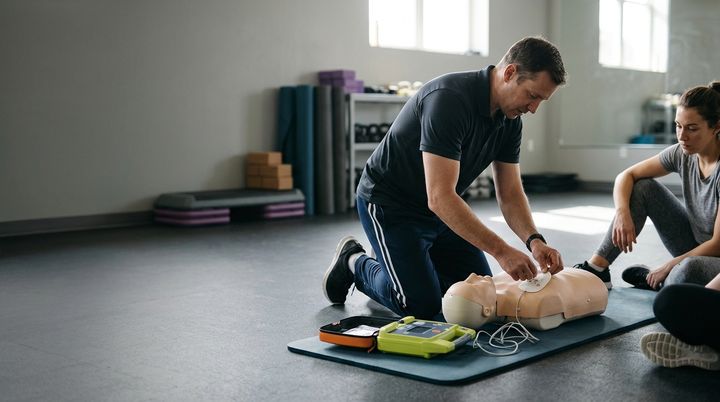
An AED, or automated external defibrillator, is a portable device that gives an electric shock to the heart of someone in cardiac arrest, to get it beating normally again. It's designed for anyone to use, with no training: once it's switched on, it talks you through every step, checks the heart's rhythm itself, and only allows a shock if one is needed.
In a cardiac arrest, every minute counts. Using an AED and starting CPR in the first few minutes, before an ambulance arrives, can be the difference between someone surviving and not. That's why more workplaces, venues and public places keep one.
AEDs at a glance
- An AED treats cardiac arrest, when the heart suddenly stops pumping properly.
- Anyone can use one. It gives spoken instructions, and it won't shock someone who doesn't need it.
- Speed matters most. Call the emergency services, start CPR and get the AED as fast as you can.
- Keep it where people can get to it quickly, clearly signed, and tell everyone where it is.
- Check it regularly: the status light, the pads' expiry date and the battery.
- Training helps confidence, but nobody should wait for a trained person before using it.
What it is, and why it matters
Cardiac arrest and heart attack
These are often confused, but they're different:
| Heart attack | Cardiac arrest | |
|---|---|---|
| What happens | Blood supply to part of the heart is blocked | The heart's electrical rhythm fails and it stops pumping blood |
| The person | Usually conscious and breathing, with chest pain | Collapses, is unresponsive and isn't breathing normally |
| What to do | Call the emergency services, keep them still and calm | Call the emergency services, start CPR, use an AED |
A heart attack can lead to a cardiac arrest, which is one reason AEDs and CPR training go together.
How an AED works
In many cardiac arrests, the heart's rhythm becomes chaotic, so the heart quivers instead of pumping. A shock can stop that chaos and let the heart's normal rhythm restart. An AED:
- Talks you through putting two sticky pads on the person's bare chest, using pictures on the pads.
- Analyses the heart's rhythm through the pads.
- Tells you whether a shock is advised, and asks everyone to stand clear.
- Gives the shock, either when you press the button or automatically, depending on the model.
- Tells you to carry on with CPR, and checks the rhythm again every couple of minutes.
If the heart's rhythm isn't one a shock can fix, the AED won't shock. You can't accidentally shock someone who doesn't need it.
Why speed matters
When the heart stops, blood stops reaching the brain. Resuscitation bodies, such as the Resuscitation Council UK, stress that each minute without CPR and defibrillation lowers the chance of survival. Ambulances take time to arrive. The people already on site are the ones who can act in those first minutes.
A worked example
A customer collapses in a busy gym. A member of staff checks him: he isn't responding and isn't breathing normally. She shouts for help and calls the emergency services on speaker. A colleague runs for the AED by reception, which is clearly signed, and she starts chest compressions.
The AED arrives within two minutes. She switches it on and follows the voice prompts. It advises a shock, everyone stands clear, and the shock is given. She carries on with CPR as the AED tells her, until the paramedics take over. The customer survives.
Two things made it work: everyone knew where the AED was, and the staff member didn't wait for permission or a first aider before using it.
How it works in practice
Using an AED
- Check for danger, then check if the person responds and is breathing normally.
- Call the emergency services and put the phone on speaker. Send someone for the AED.
- Start CPR: firm, fast chest compressions in the centre of the chest.
- Switch on the AED as soon as it arrives and follow its instructions.
- Keep going with CPR and the AED's prompts until help arrives and takes over, or the person starts breathing normally.
The call handler on the emergency line can talk you through CPR and tell you where the nearest public AED is.
Where to keep it
- Somewhere central and easy to reach quickly from anywhere on site, ideally within a short walk.
- Clearly signed, with signs pointing to it from around the building.
- Not locked away where only one person has the key. If it's in a cabinet, everyone should know how to open it.
- Near where people are most at risk, such as a gym floor, a busy venue or a reception.
Many areas keep a register of AEDs so emergency call handlers can direct callers to the nearest one. Registering yours means it can help people outside your building too.
Keeping it ready
An AED that doesn't work when needed is worse than none, because people waste precious time on it. A quick regular check, done weekly or monthly, covers:
| Check | What to look for |
|---|---|
| Status indicator | A green light, tick or "OK" display. A red light or beep means it needs attention |
| Pads | In date, sealed, and the right size. Child pads too, if children use the site |
| Battery | In date, and charged where the model shows it |
| Accessories | Gloves, scissors to cut clothing, a razor and a towel are often kept with it |
| Location | In its place, signed, and nothing blocking it |
| After use | Replace the pads and check the battery straight away |
Our AED check turns this into a quick routine, with an alert when pads or batteries are coming up to their expiry dates.
Training
Anyone can use an AED, but people who've practised CPR and seen an AED used are faster and more confident. Short sessions as part of first aid training, or a refresher at a team meeting, take the fear out of it. Keep the AED check alongside your first aid kit check, so both get looked at together.
Common mistakes and myths
| What people say | What's actually true |
|---|---|
| "Only trained first aiders can use it" | AEDs are designed for anyone. Use it straight away |
| "I might shock someone who doesn't need it" | The AED checks the rhythm and won't shock unless it's needed |
| "We'll wait for the ambulance" | Every minute counts. Start CPR and use the AED now |
| "It's locked in the office for safety" | An AED nobody can get to quickly can't help |
| "It's fine, we checked it when we bought it" | Pads and batteries expire. Check it regularly |
| "CPR isn't needed once the AED is on" | The AED tells you to keep doing CPR between shocks |
Rules where you are
Whether a workplace must have an AED, what first aid cover is needed and how first aiders are trained differ by country, and sometimes by state or province. These regulators keep their own pages up to date, so check yours:
- Great Britain: the Health and Safety Executive, frequently asked questions on first aid
- Northern Ireland: HSENI, first aid at work
- Ireland: the Health and Safety Authority, first aid FAQs
- United States: OSHA, AEDs in the workplace, plus your state's rules
- Canada: the Canadian Centre for Occupational Health and Safety, automated external defibrillators, plus your province's workplace safety regulator
- Australia: Safe Work Australia, first aid
- New Zealand: WorkSafe, first aid at work
FAQ
What is an AED?
An automated external defibrillator: a portable device that checks the heart's rhythm and, if needed, gives a shock to help a heart in cardiac arrest start beating normally again. It talks the user through each step.
Can anyone use an AED?
Yes. AEDs are designed for people with no training. They give clear spoken instructions and only allow a shock if the heart's rhythm needs one.
Can an AED hurt someone?
It won't shock someone whose heart doesn't need it, because it checks the rhythm first. Make sure nobody is touching the person when the shock is given, as the AED will tell you.
How often should an AED be checked?
Regularly, often weekly or monthly. Check the status light, the expiry dates of the pads and battery, and that it's in its place and easy to reach. Replace the pads after any use.
What is the difference between a heart attack and a cardiac arrest?
In a heart attack, blood flow to part of the heart is blocked, and the person is usually conscious. In a cardiac arrest, the heart stops pumping, and the person collapses and stops breathing normally. An AED is used for cardiac arrest.