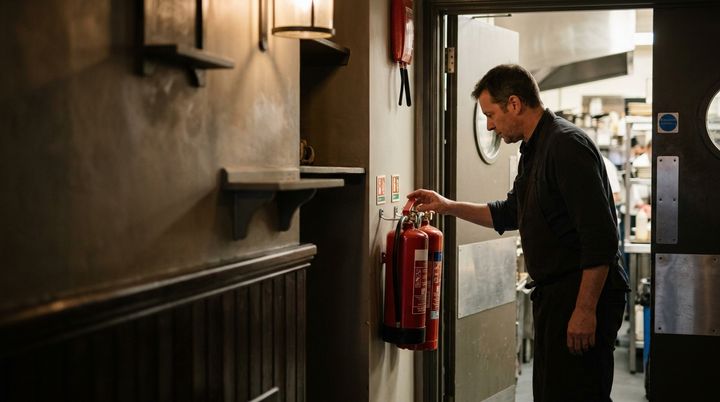
Types of Fire Extinguisher
Types of fire extinguisher: which fire each one is for, and why kitchens need wet chemical

Liam Jones

Founder of Pilla
Date Modified
22 November 2026


Date modified: 22nd November 2026 | This article has been written by Pilla Founder, Liam Jones, click to email Liam directly, he reads every email.
Each type of fire extinguisher is made for certain kinds of fire, and the wrong one can make a fire worse. Here is what each type does, how to tell them apart, why kitchens need wet chemical, and how to check and use one.
Article Content
The types of fire extinguisher are water, foam, dry powder, carbon dioxide (CO2) and wet chemical, plus a few specialist ones. Each is made to put out certain kinds of fire, and using the wrong one can spread the fire or hurt the person holding it. Water on a fat fire, for example, turns to steam in an instant and throws burning oil across the kitchen.
So the type that sits on the wall matters. It should match what could catch fire nearby, and the people who work there should know what it's for.
Types of fire extinguisher at a glance
- Water: for paper, wood, fabric and other solid materials. Never on fat, oil or live electrics.
- Foam: for solids and burning liquids such as petrol or paint. Not for cooking oil.
- Dry powder: for solids, liquids and gases. It makes a thick cloud, so it's a poor choice indoors in small rooms.
- CO2: for electrical fires and burning liquids. It leaves no mess, but it gives little protection once the gas clears.
- Wet chemical: for cooking oil and fat fires. This is the one a commercial kitchen needs by the fryer.
- Read the label, not just the colour. Colour codes differ by country, but every extinguisher's label says what it's for.
What it is, and why it matters
A fire needs three things: heat, fuel and oxygen. Take one away and it goes out. Each extinguisher works by removing one or more of them. Water cools. Foam smothers the surface of a liquid. CO2 pushes away the oxygen. Powder interrupts the chemical reaction. Wet chemical cools burning fat and forms a soapy layer on top that seals it off.
That's why there's no single type for everything. Fuel decides the fire, and the fire decides the extinguisher.
The classes of fire
Fires are grouped into classes by what's burning. The letters used differ between countries, but the groups are much the same everywhere:
| What's burning | Examples | Often called |
|---|---|---|
| Solid materials | Paper, cardboard, wood, fabric, plastics | Class A |
| Flammable liquids | Petrol, solvents, paint, spirits | Class B |
| Flammable gases | Propane, butane, natural gas | Class C in some countries |
| Metals | Magnesium, lithium, aluminium swarf | Class D |
| Cooking oil and fat | Deep fat fryers, woks, griddles | Class F in some countries, class K in others |
| Live electrical equipment | A burning plug, a sparking appliance | Treated as its own group, or class C or E, depending on the country |
Check the classes printed on the extinguisher against the list your own country uses.
Which extinguisher for which fire
| Type | Use on | Never use on | Good to know |
|---|---|---|---|
| Water | Solids | Cooking oil, flammable liquids, live electrics | Cheap and simple. Water mist versions behave differently, so check the label |
| Foam | Solids, flammable liquids | Cooking oil, and live electrics unless the label says it's been tested for that | Common in offices and shops |
| Dry powder | Solids, liquids, gases, some electrical fires | Cooking oil; small enclosed rooms where people stay inside | The cloud makes it hard to see and breathe, and it ruins electronics |
| CO2 | Live electrical kit, flammable liquids | Cooking oil; solids, where it may reignite | The horn gets extremely cold, so hold it by the handle. It can make breathing hard in a small room |
| Wet chemical | Cooking oil and fat fires, and often solids | Live electrics unless the label allows | Apply gently, from a distance, so the oil doesn't splash |
| Special powder | Metal fires | Anything else | Only where metals are worked or stored |
A fire blanket is often kept next to a wet chemical extinguisher. It's good for a small pan fire or wrapping a person whose clothes have caught. Turn off the heat first if you can, lay the blanket over the pan and leave it there to cool.
Why kitchens need wet chemical
Oil in a fryer can burn at very high temperatures. If you smother the flames but don't cool the oil, it can reignite as soon as the air gets back in. Water is worse still: it sinks under the oil, boils in a fraction of a second and erupts upward in a fireball. Wet chemical cools the oil and seals the surface at the same time, which is why a commercial kitchen with a fryer keeps one close by, not just a powder or CO2.
A worked example
A pub kitchen has a two-basket fryer, a griddle and a CO2 extinguisher by the door. During a fire risk assessment, the manager spots the gap: the CO2 is right for the electrical panel, but there's nothing for an oil fire. They add a wet chemical extinguisher and a fire blanket near the fryer, on the escape side so nobody has to reach past the flames. The CO2 moves closer to the electrics. Both go into the monthly fire extinguisher check.
How to tell them apart
Extinguishers carry a label that sets out the type, the classes of fire it's for, what not to use it on and how to use it, usually with pictures. Many countries also use colour: in some the whole body is a colour, in others there's a coloured band or panel on a red body. Because the colour codes aren't the same everywhere, teach people to read the label. A quick check of the label during training stops someone grabbing the nearest red cylinder in a panic.
Checking an extinguisher
A quick check every month, by someone on site, catches most problems:
- It's in its place, on its bracket or stand, and easy to reach.
- Nothing blocks it, and its sign is visible.
- The pin and tamper seal are in place.
- The pressure gauge, where there is one, shows the needle in the green.
- There's no damage, rust, leaking or a blocked hose or nozzle.
- The service label is in date.
Anything that fails goes to whoever arranges servicing. On top of this, a competent service engineer should service extinguishers at intervals set by the manufacturer and your local rules, and replace or refill any that have been used, even briefly.
Using one safely
Only fight a fire if you've been trained, the fire is small, the alarm has been raised and you have a clear way out behind you. If it doesn't go out quickly, leave, close the door and get out.
A common way to remember the steps is PASS:
- Pull the pin.
- Aim at the base of the fire, not the flames.
- Squeeze the handle.
- Sweep from side to side until it's out.
For wet chemical on a fryer, hold the nozzle well above the oil and apply it gently so it settles on the surface rather than splashing. Turn the heat source off if you can do it safely. Our fire emergency training covers this with your team.
Common mistakes and myths
| What people say | What's actually true |
|---|---|
| "Any extinguisher will do" | The wrong type can spread the fire or injure you |
| "Water on a chip pan will cool it down" | Water on burning oil erupts into a fireball |
| "Powder is the safe all-rounder" | It doesn't work on cooking oil, and it's hard to see and breathe in a small room |
| "CO2 is fine for any fire" | On solids it can go out and reignite once the gas clears |
| "The colour tells you everything" | Colour codes differ by country. Read the label |
| "We've never used it, so it's fine" | Pressure drops and seals fail. Check it monthly and have it serviced |
| "A bit was used, but it's still mostly full" | Once an extinguisher is used, it needs refilling or replacing |
Rules where you are
Which extinguishers a workplace needs, how many, where they go and how often they're serviced is set by fire safety law, which differs by country and sometimes by state or province. These regulators and fire authorities keep their own pages up to date, so check yours:
- England and Wales: GOV.UK, fire safety in the workplace
- Scotland: the Scottish Government, non-domestic fire safety
- Northern Ireland: the Northern Ireland Fire & Rescue Service, business fire safety
- Ireland: the Health and Safety Authority, emergency escape and fire fighting
- United States: OSHA, portable fire extinguishers, plus your state and local fire code
- Canada: the Canadian Centre for Occupational Health and Safety, portable fire extinguishers, plus your province's fire code
- Australia: Safe Work Australia, emergency plans and procedures, plus your state or territory fire authority
- New Zealand: Fire and Emergency New Zealand, commercial use of fire extinguishers
FAQ
What are the main types of fire extinguisher?
Water, foam, dry powder, carbon dioxide (CO2) and wet chemical. Some workplaces also have water mist or special powder extinguishers for particular risks.
Which fire extinguisher do I need in a commercial kitchen?
A wet chemical extinguisher near the fryer for oil and fat fires, often with a fire blanket. Most kitchens also need something for electrical fires, such as CO2, near the electrics.
Can you use a CO2 extinguisher on a chip pan fire?
It's not the right choice. CO2 can knock the flames down, but it doesn't cool the oil, so the fire can flare up again as soon as the gas clears. Use wet chemical or a fire blanket.
How often should fire extinguishers be checked?
Give them a quick visual check on site every month, and have them serviced by a competent engineer at the intervals the manufacturer and your local rules set. Refill or replace any that have been used.
Why are fire extinguishers different colours?
Colour helps people pick the right one quickly, but the colour codes differ by country. The label on every extinguisher says what type it is and which fires it's for, so teach people to read that.