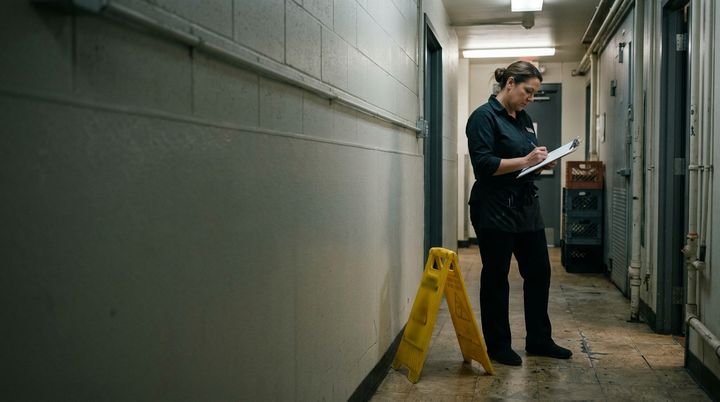
Incident Reporting
What is incident reporting? Why you record accidents and near misses, and what to write down

Liam Jones

Founder of Pilla
Date Modified
22 November 2026


Date modified: 22nd November 2026 | This article has been written by Pilla Founder, Liam Jones, click to email Liam directly, he reads every email.
Incident reporting means recording accidents, near misses and work-related ill health, then using the record to stop it happening again. Here is what counts, what to write down, how to look into the cause, and why some incidents must also go to a regulator.
Article Content
Incident reporting is the habit of recording every accident, near miss and case of work-related ill health, looking into why it happened, and changing something so it doesn't happen again. Most of what gets reported stays inside the business. Some serious incidents must also be reported to a regulator, and which ones depends on where you are.
The point isn't the paperwork. It's that every incident is a free lesson. A wet floor that nearly put someone on their back is a warning. Write it down and fix it, and the next person doesn't end up in hospital.
Incident reporting at a glance
- Report everything: injuries, near misses, dangerous events and work-related ill health.
- Near misses matter most for prevention. They show the problem before anyone gets hurt.
- Write it down quickly, while people remember the details.
- Look for the cause, not someone to blame. Ask why, and keep asking.
- Act on it. A report that changes nothing teaches people not to bother.
- Some incidents must also go to a regulator, within a time limit. Check the rules where you are.
What it is, and why it matters
What counts as an incident
| Type | What it means | Example |
|---|---|---|
| Accident | An event that causes injury or damage | A chef burns a hand on a tray from the oven |
| Near miss | An event that could have caused harm, but didn't | A box falls from a high shelf and lands where someone was standing a moment earlier |
| Dangerous occurrence | A serious event that could have caused serious harm | A gas leak, a collapsed shelving unit, an electrical fire |
| Work-related ill health | Illness caused or made worse by work | Dermatitis from wet work, back pain from lifting |
| Violence or abuse | Physical or verbal aggression towards staff | A customer threatens a member of staff at the bar |
Why near misses matter
For every serious injury, there are usually many minor ones and far more near misses, all with the same causes. A near miss is the cheapest possible way to find a hazard: nobody was hurt, nothing was damaged, and you get to fix it anyway.
The trouble is that near misses are easy to shrug off. "Nothing happened" feels like the end of it. Making near miss reporting quick and normal is how you catch them. Our near miss report takes a few taps on a phone.
A worked example
In one week, three different staff in a restaurant mention slipping on the same stretch of floor by the dish wash. Nobody falls. Nobody reports it, because nobody was hurt.
The next week, a server carrying a tray of glasses goes down there, cuts her hand and sprains her wrist. When the manager looks into it, the cause is clear: the glass washer has been leaking for a fortnight, and the mat that should catch the drips had been moved.
If the first slip had been reported as a near miss, the leak would have been found and fixed for the price of a call-out. The accident report led to the fix, but only after someone got hurt.
How it works in practice
Step 1: Deal with the immediate situation
Make the area safe, give first aid, and call the emergency services if needed. Keep anything that might help explain what happened, such as broken equipment, as it is, if it's safe to.
Step 2: Record it
Write it down as soon as possible, ideally the same shift. Keep it factual:
| What to record | Why |
|---|---|
| Date, time and exact place | To spot patterns and hotspots |
| Who was involved, and any witnesses | So you can ask them later |
| What happened, in their words | The facts before memories fade |
| Any injury, and the treatment given | For care and any follow-up |
| What they were doing at the time | The task often points to the cause |
| Equipment, substances or conditions involved | Wet floor, broken step, faulty kit |
| Photos | Worth a page of description |
| Immediate action taken | What made it safe |
Our accident reporting workflow collects this on the spot, with photos. Keep personal details secure and only share them with people who need them.
Step 3: Look into the cause
For anything beyond the trivial, ask why it happened, then ask why again. Most incidents have several causes stacked up: the immediate one (the floor was wet), the underlying one (the glass washer was leaking) and the root one (nobody was responsible for checking it, and the fault report sat unread).
Talk to the people involved and the people who do the job every day. They usually know the real cause. Avoid stopping at "human error" or "not paying attention". People make mistakes; the question is why the system made the mistake easy and the harm likely.
Step 4: Decide what to change, and do it
Pick changes that tackle the cause, not just the symptom. "Remind staff to be careful" rarely works. Fixing the leak, putting the mat back and adding the glass washer to the weekly check does. Update your risk assessment if the incident showed it missed something.
Step 5: Close the loop
Tell the person who reported it what changed. Share lessons with the team, without naming and shaming. People keep reporting when they see their reports lead somewhere.
Step 6: Look at the trends
Once a month, read back through the reports. Is there a place, a task, a time of day, a piece of kit or a type of injury that keeps coming up? Patterns tell you where to look harder. Repeated strains from lifting might point to a manual handling problem, for example.
Step 7: Check whether it must go to a regulator
In most countries, some incidents must be reported to a workplace safety regulator, usually the most serious: deaths, serious injuries, injuries that keep someone off work for a set time, some diseases and some dangerous events. The list, the time limit and how to report all differ by country, so check the link for yours below. Your own record is still needed either way.
Building a reporting culture
The biggest barrier to incident reporting is fear: of blame, of looking clumsy, of getting someone in trouble. A few things help:
- Make reporting fast, simple and possible from a phone.
- Thank people for reporting, especially near misses.
- Treat reports as information, not confessions.
- Act visibly on what's reported.
- Make sure managers report too.
Common mistakes and myths
| What people say | What's actually true |
|---|---|
| "Nobody was hurt, so there's nothing to report" | Near misses are the most useful reports there are |
| "We only report what the regulator needs" | Most incidents never reach a regulator, but you still learn from them |
| "It was human error" | People make mistakes. Ask what made the mistake possible and the harm likely |
| "Reporting makes us look bad" | A business with lots of near miss reports usually has fewer serious accidents |
| "The accident book is enough" | A record that nobody reads or acts on prevents nothing |
| "I'll write it up at the end of the week" | Details fade fast. Record it the same shift |
Rules where you are
Which incidents must be reported to a regulator, how quickly, and which records employers must keep differ by country. These regulators keep their own pages up to date, so check yours:
- Great Britain: the Health and Safety Executive, types of reportable incidents (RIDDOR)
- Northern Ireland: HSENI, accident reporting
- Ireland: the Health and Safety Authority, accident and dangerous occurrence reporting
- United States: OSHA, report a fatality or severe injury and recordkeeping
- Canada: the Canadian Centre for Occupational Health and Safety, incident investigation, plus your province's workplace safety regulator for what must be reported
- Australia: Safe Work Australia, incident notification
- New Zealand: WorkSafe, what events need to be notified
FAQ
What is incident reporting?
Recording accidents, near misses, dangerous events and work-related ill health, then looking into why they happened and making changes so they don't happen again.
What is the difference between an accident and an incident?
An accident is an event that causes injury or damage. An incident is the wider term: it includes accidents and also near misses and dangerous events where nobody was hurt.
Why should near misses be reported?
A near miss has the same causes as an accident, but nobody was hurt. Reporting it lets you fix the hazard before it injures someone.
What should an incident report include?
The date, time and place, who was involved and who saw it, what happened, any injury and treatment, what they were doing, the conditions or equipment involved, photos and the action taken.
Do all workplace accidents have to be reported to a regulator?
No. Only certain serious incidents must go to a regulator, and the list differs by country. You should still record every accident and near miss for yourself.